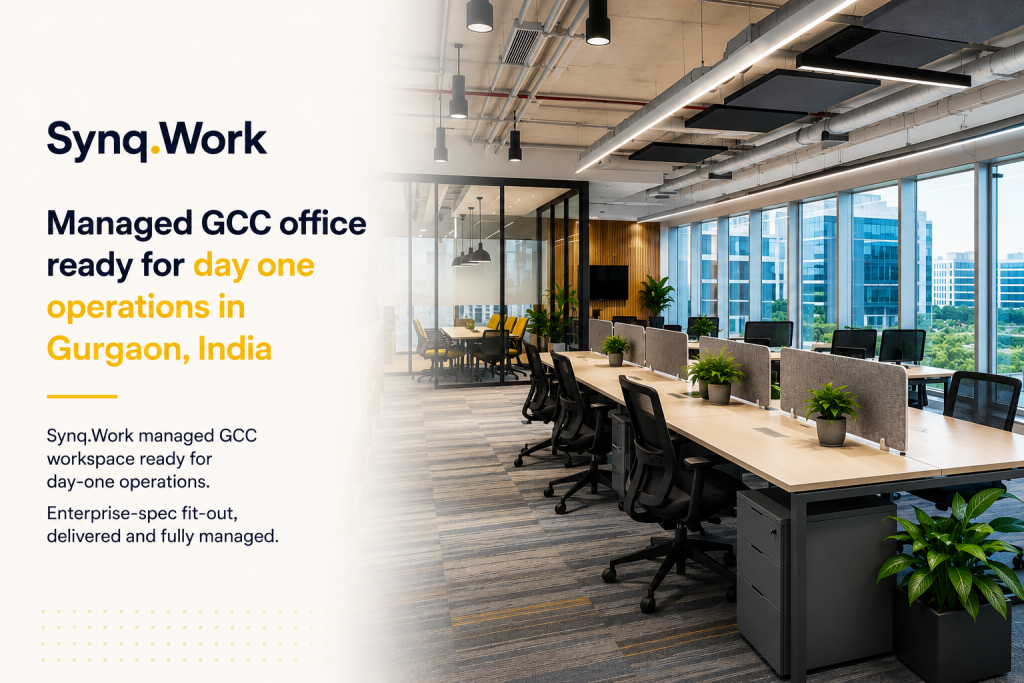
Week-by-week. Phase-by-phase. What actually happens between signing the decision memo and putting your first team at their desks in India.
A conventional GCC build takes 12 to 18 months. Most of that time is consumed by real estate sourcing, fit-out procurement, and vendor coordination, not by entity formation or hiring. With Synqwork’s MO-GCC (Managed Office-Global Capability Center) model, the workspace is delivered and fully managed in parallel with entity registration. The result: your GCC is operational, your team is at their desks, and delivery to HQ has started within 60 to 90 days. This guide walks through exactly what happens in each phase.
1. The case for speed: why 60 days, not 18 months
Every week a GCC is not operational is a week of unrealised cost savings, unhired talent moving to a competitor’s offer, and a board that is asking why India is taking so long.
The conventional GCC setup timeline looks something like this: 2 to 3 months to shortlist cities and negotiate a lease. Another 4 to 6 months for fit-out, furniture procurement, and IT infrastructure installation. Then 2 to 3 months of compliance setup, payroll configuration, and first hires. End to end, that is 12 to 18 months from board approval to the first engineer writing code at a desk in India.
The problem is not that any single step takes too long. The problem is that every step waits for the previous one to finish. Entity registration waits for city selection. Workspace waits for entity registration. Hiring waits for workspace. Compliance waits for hiring. It is a waterfall, and waterfalls are slow.
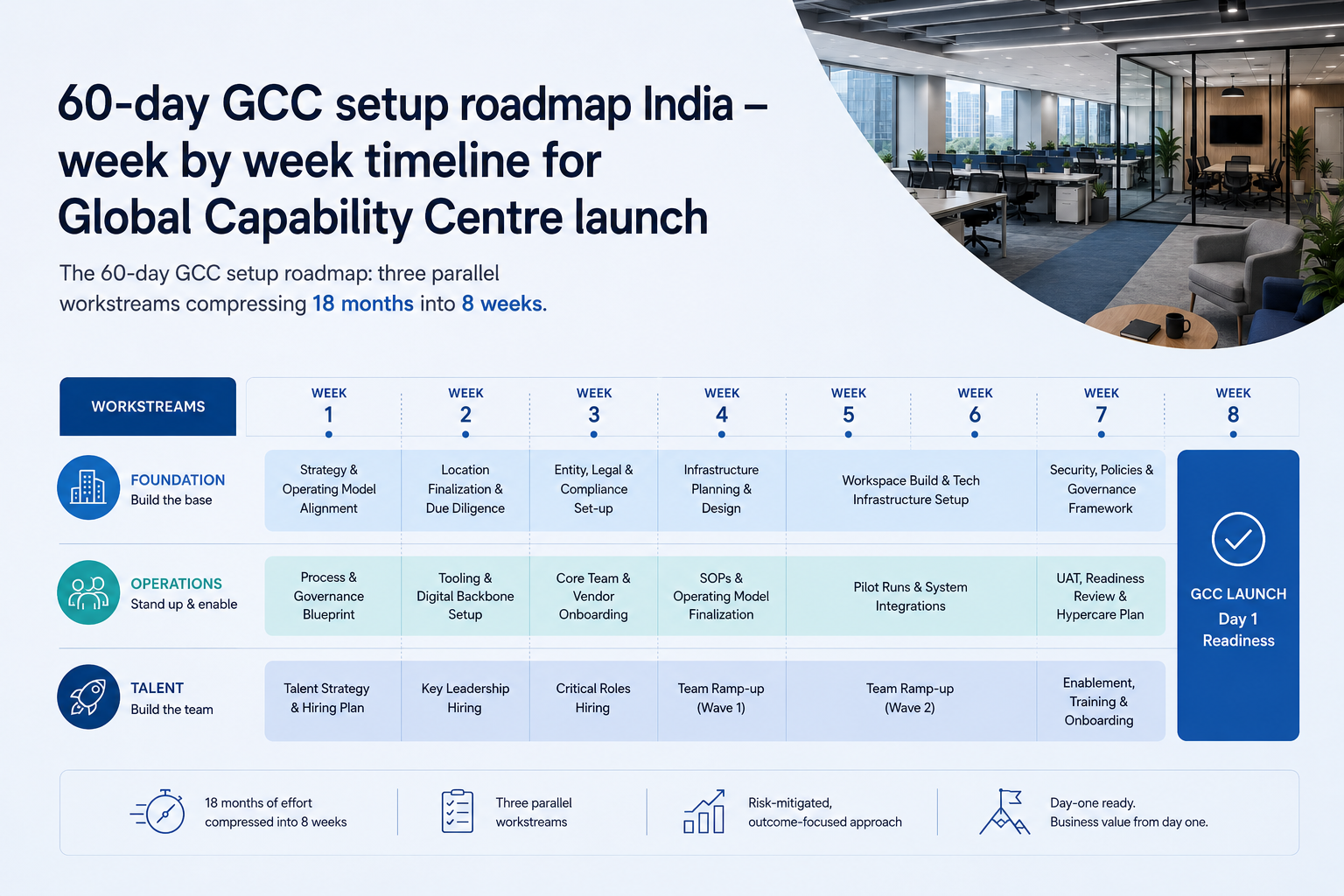
The 60-day roadmap works because it breaks the waterfall. With a MO-GCC partner like Synqwork handling workspace delivery and end-to-end operations, three workstreams run in parallel from Day 1: legal and entity formation, workspace build-out and IT infrastructure, and talent pipeline development. Nothing waits for anything else.
BMW TechWorks India is a useful reference. The BMW Group and Tata Technologies joint venture launched in late 2024 with 100 employees across Pune, Bengaluru, and Chennai, then scaled to over 1,000 employees within a year. That kind of ramp is only possible when the workspace, compliance, and hiring infrastructure are already in place before the headcount curve starts climbing.
In a self-build, your GCC Head spends the first 6 months managing real estate brokers, interior designers, IT vendors, security contractors, and housekeeping agencies. In a MO-GCC model, Synqwork handles all of that. Your GCC Head spends the first 6 months hiring, building the team, and starting delivery. Same person, same salary, completely different output.
2. Phase 1 (Days 1–15): Entity formation and legal setup
This is where the legal entity comes to life. The standard structure for a GCC in India is a Private Limited Company registered under the Companies Act, 2013. Everything runs through the SPICe+ (Simplified Proforma for Incorporating Company Electronically Plus) portal with the Ministry of Corporate Affairs.
What gets done in Days 1–15:
- Appoint a legal and compliance advisory partner (CA firm, CS firm, or Big 4 affiliate)
- Obtain Digital Signature Certificates (DSC) for all proposed directors
- Apply for Director Identification Numbers (DIN)
- File SPICe+ application with MCA (includes company name reservation, PAN, TAN allocation)
- Draft and file Memorandum of Association (MoA) and Articles of Association (AoA)
- Initiate registered office address documentation
- Begin RBI FDI reporting preparation (Form FC-GPR, due within 30 days of FDI receipt)
What Synqwork handles in parallel:
While entity paperwork moves through MCA, Synqwork begins workspace planning. Site selection, floor plan design, branding specifications, IT infrastructure requirements, and security protocols are all scoped during Days 1 to 15. The workspace build-out starts before entity registration completes. This is the single biggest time compression in the entire roadmap.
At least one director must have resided in India for a minimum of 120 days in the preceding financial year. If your organisation does not have a resident director, identify and appoint one early. This is a common bottleneck that catches first-time entrants off guard.
3. Phase 2 (Days 16–30): Workspace and IT infrastructure
This is the phase where most GCC launches either accelerate or stall. In a conventional build, workspace procurement alone takes 6 to 9 months: shortlisting properties, negotiating lease terms, appointing an interior designer, tendering the fit-out contract, procuring furniture, installing structured cabling, setting up server rooms, and coordinating 8 to 15 separate vendors for everything from HVAC to housekeeping.
With Synqwork’s MO-GCC model, all of that is handled by one partner under one contract. The workspace is not just delivered. It is fully managed, end-to-end, from day one.
What gets done in Days 16–30:
- Workspace customisation: floor plan finalised to client specifications, branding elements installed
- Enterprise IT infrastructure: fibre connectivity, structured cabling, enterprise Wi-Fi, UPS and DG backup
- Security systems: biometric access control, CCTV, visitor management system, dedicated network perimeter
- Server room and comms room setup (if required for on-premise workloads)
- Leased line activation and ISP redundancy configuration
- Furniture installation: workstations, meeting rooms, phone booths, collaboration zones, leadership cabins
- Facilities readiness: pantry, cafeteria, reception desk, mail room, housekeeping protocols
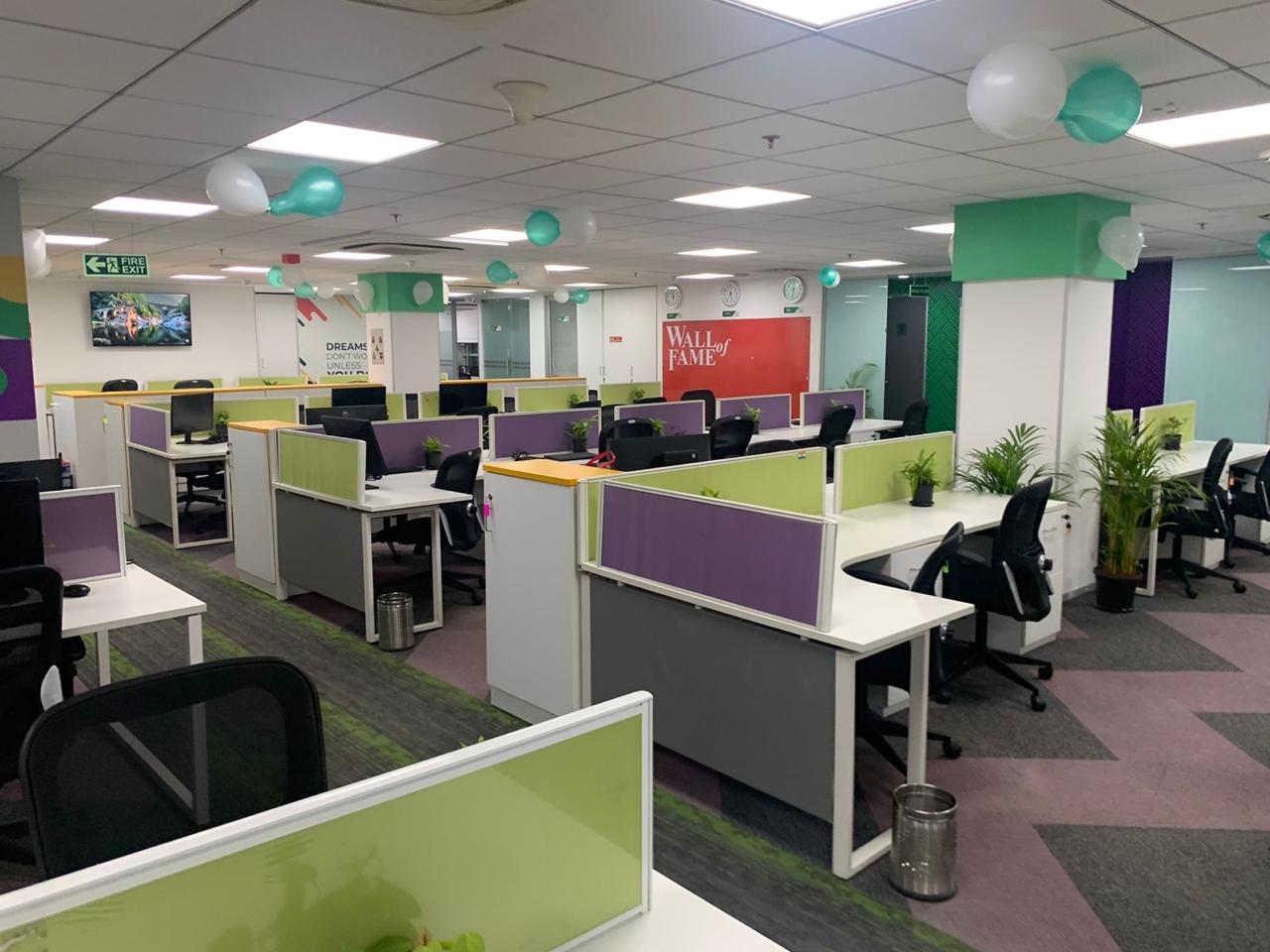
Synqwork does not hand over a fitted-out shell and walk away. MOGCC means Synqwork manages end-to-end operations for the life of the engagement: the fit-out, the IT infrastructure, the security, the facilities, the housekeeping, the cafeteria, the reception, the maintenance, the vendor relationships. The GCC occupies a fully managed, enterprise-grade workspace from Day 1. No facilities team to hire. No vendor coordination to manage. No operational distractions for leadership.
4. Phase 3 (Days 31–50): HR, payroll, and first hires
By Day 31, the entity is registered, the workspace is nearing completion (or already operational), and the recruitment pipeline that was activated in Phase 1 is producing candidates. This phase is about converting that pipeline into people at desks.
What gets done in Days 31–50:
- Employees’ Provident Fund (EPF) registration with EPFO
- Employee State Insurance Corporation (ESIC) registration
- Professional Tax registration (state-specific)
- Payroll system setup: TDS computation, salary structuring, CTC breakdowns
- Shops and Establishments Act registration (state-level)
- Employment contracts and offer letter templates drafted and reviewed by legal
- GCC Head and first functional leaders join (if not already onboarded)
- First batch of 10 to 20 hires: engineers, analysts, or operations staff onboarded
- Employee onboarding process: IT equipment provisioning, access card issuance, orientation
The 60-to-90-day notice period reality
India’s standard notice period for experienced professionals is 60 to 90 days. This means that if you want engineers seated by Day 50, offers need to go out by Day 1 or even before entity registration is complete. The best GCC launches pre-engage recruitment partners during the decision phase, before any legal filing begins. By the time the office is ready, the first batch of candidates has already served their notice period and is ready to join.
Expect a 15 to 25% drop-out rate between offer and joining. Candidates receive 2 to 4 counteroffers during the notice period. Over-pipeline by 20 to 30% to account for this.
Hire top-down. GCC Head and functional leads first, then senior ICs, then mid-level, then junior. A 25-person team with a 60% senior-to-mid ratio outperforms a 40-person team with a junior-heavy composition. The first 10 hires set the engineering culture, the hiring bar, and the delivery cadence for the next 100.
5. Phase 4 (Days 51–60): Compliance, go-live, and operations
The final stretch. The entity is registered, the office is operational, the first team members are at their desks. This phase is about closing compliance gaps, locking down security, and starting delivery.
What gets done in Days 51–60:
- GST registration finalised (if not already completed with SPICe+)
- IT security audit: network penetration testing, endpoint protection validation, access control review
- DPDP Act 2023 compliance: consent mechanisms, breach notification protocols, data processing agreements
- Transfer pricing documentation: arm’s length pricing structure, benchmarking study initiated
- Operational SOPs documented: escalation matrix, facilities requests, IT support ticketing, visitor management
- Team onboarding orientation: company values, global team introductions, HQ alignment meetings
- First deliverables shipped to parent company
- Synqwork ongoing operations: workspace management continues under MO-GCC contract
By Day 60, the GCC is operational. Not in a planning phase. Not in a “soft launch.” Operational, with people writing code, running analyses, or executing processes that create value for the parent organisation. The workspace is fully managed by Synqwork. The GCC leadership team is focused entirely on scaling the team and expanding the mandate.
Go-live is not the finish line. It is the starting point. Synqwork continues managing end-to-end workspace operations: facilities, IT infrastructure, security, housekeeping, cafeteria, and maintenance. As the GCC scales from 50 to 200 to 500 seats, Synqwork handles expansion through contiguous floors and warm shell buffers built into the original engagement. The GCC leadership never has to revisit the real estate question.
6. The 60-day timeline: week-by-week view
| Week | Workstream 1: Legal & Entity | Workstream 2: Workspace (Synqwork) | Workstream 3: Talent & HR |
|---|---|---|---|
| Week 1–2 | DSC, DIN applications filed. SPICe+ application submitted. Legal advisory engaged. | MO-GCC engagement signed. Site selected. Floor plan and branding spec confirmed. | Recruitment partners engaged. GCC Head search activated. Job descriptions drafted. |
| Week 3–4 | MCA processes SPICe+. PAN, TAN allocated. MoA/AoA filed. | Fit-out underway. IT cabling and networking installed. Furniture ordered. | Leadership interviews in progress. First batch of functional role candidates shortlisted. |
| Week 5–6 | Entity registration complete. EPF, ESIC, Shops & Establishments filed. | Workspace nearing completion. Access control and CCTV live. ISP activated. | GCC Head joins. First offers extended. Payroll system configured. |
| Week 7 | RBI FDI filing (FC-GPR). GST finalised. TP documentation initiated. | Workspace operational. Facilities management live. Cafeteria and reception active. | First 10–15 hires onboarded. IT equipment provisioned. Orientation completed. |
| Week 8 | DPDP compliance documentation complete. Security audit passed. | Ongoing MO-GCC operations: Synqwork manages workspace end-to-end. | Team at desks. First deliverables to HQ. Scale hiring continues. |
7. Common mistakes that delay GCC setup
1. Running the workspace search after entity registration
Entity registration takes 2 to 4 weeks. If you wait for it to complete before starting the workspace search, you have added 6 to 9 months to the timeline for no reason. A MO-GCC partner should be engaged on Day 1, not Day 30.
2. Choosing the wrong entity structure
A Private Limited Company via SPICe+ is the standard and fastest route. LLPs have restrictions on FDI that create downstream complications. Branch offices require RBI approval and cannot hire independently. Section 8 companies are for non-profits. Get legal advice early and pick the structure that matches the mandate.
3. Slow IT procurement
Ordering enterprise laptops, monitors, and peripherals from global procurement channels takes 6 to 8 weeks in India. If IT hardware ordering waits until the office is ready, the first hires have desks but no machines. Pre-order hardware the moment headcount is approved. Or use a MOGCC provider whose IT infrastructure package includes pre-provisioned workstations.
4. Ignoring the 60-to-90-day notice period
Every experienced hire in India comes with a 60-to-90-day notice period. If you start recruitment on Day 30, your first hires will not be available until Day 90 to 120. Recruitment should start before entity registration, not after workspace handover. Pipeline first, then convert once the entity is live.
5. Not having a managed workspace partner
The single biggest predictor of whether a GCC launches in 60 days or 12 months is whether the workspace is handled by a dedicated MOGCC partner or managed in-house. In-house means the GCC Head becomes a part-time real estate project manager. A MO-GCC partner like Synqwork means the GCC Head is a full-time capability builder from week one.
8. FAQ: GCC setup timeline
How quickly can a GCC be set up in India?
With a MO-GCC partner like Synqwork handling workspace delivery and end-to-end operations, a GCC can be operational in 60 to 90 days. The key is parallel execution: entity registration, workspace build-out, and talent pipeline development run simultaneously rather than sequentially. A conventional self-build without a managed partner takes 12 to 18 months because each phase waits for the previous one to complete.
What happens in the first 60 days of GCC setup?
Days 1 to 15: entity incorporation via SPICe+, legal advisory engagement, and MO-GCC partner engagement with workspace planning starting immediately. Days 16 to 30: workspace customisation and IT infrastructure installation by Synqwork while entity registration completes. Days 31 to 50: EPF and ESIC registration, payroll setup, first 10 to 20 hires onboarded. Days 51 to 60: compliance finalisation, IT security audit, operational SOPs, and go-live with first deliverables shipped to HQ. Synqwork continues managing the workspace end-to-end after go-live.
What is the fastest way to launch a GCC in India?
Engage a MOGCC partner from Day 1. The fastest path is one where the enterprise focuses on entity formation, hiring, and capability building while a single partner like Synqwork delivers and manages the entire workspace: fit-out, IT infrastructure, security, facilities, and ongoing operations. This eliminates the 6 to 9 months typically lost on real estate sourcing, fit-out procurement, and multi-vendor coordination. Synqwork provides fully managed offices across New Delhi, Gurugram, Faridabad, Mumbai, and Chennai with a 60-to-90-day go-live commitment.
Go live in 60 days with Synqwork
Ready to launch your GCC in India? Synqwork’s MO-GCC model delivers fully managed, enterprise-grade workspace across New Delhi, Gurugram, Faridabad, Mumbai, and Chennai. End-to-end operations. One partner. One fee. Zero CapEx.
Talk to our setup teamRelated reading
How to set up a GCC in India: Complete 2026 guide
GCC Compliance in India: Entity Formation, Labour Law, GST & DPDP Act 2025
GCC office space and managed workspace in India
Data sources and credits
- BMW Group / Tata Technologies — Official press release, October 2024: BMW TechWorks India JV launch, 100 employees across Pune, Bengaluru, Chennai with planned rapid scale to 1,000+ by end 2025
- NASSCOM-Zinnov — GCC Landscape in India 2026 Report (GCC count, workforce, and revenue data)
- Ministry of Corporate Affairs — SPICe+ portal and Companies Act 2013 entity registration framework
- Reserve Bank of India — FEMA 1999 FDI reporting requirements (Form FC-GPR)
- EPFO / ESIC — Provident Fund and Employee State Insurance registration requirements
- Digital Personal Data Protection Act, 2023 — Data processing compliance framework
- Union Budget 2026 — Transfer pricing safe harbour margin (15.5%), threshold revisions
- LinkedIn India Talent Insights 2025 — Notice period and offer drop-out rate data
- JLL India / CBRE — GCC office leasing timelines and fit-out benchmarks
All data is current as of May 2026. Timelines referenced are based on Synqwork’s MO-GCC delivery model with parallel execution. Actual timelines may vary based on city, team size, compliance complexity, and entity structure. Contact Synqwork for a tailored setup plan.