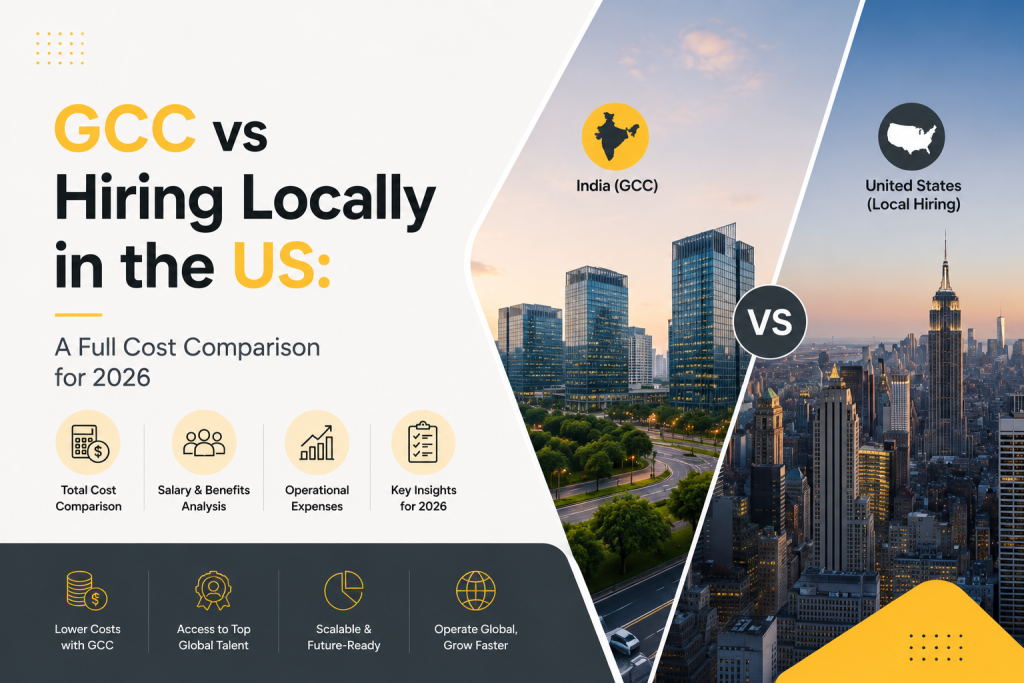
Every finance leader evaluating a Global Capability Centre mandate asks the same question first: what does this actually save us? Here is the honest, disaggregated answer: salaries, real estate, benefits load, and total cost of ownership, US versus India.
A GCC in India typically costs 40 to 50% less than an equivalent US team in Year 1, and 60 to 70% less on an ongoing basis from Year 2 onward once setup costs are absorbed. The savings are driven primarily by engineering compensation, which is significantly lower in India even at senior levels, combined with lower real estate and operational costs. But the more important 2026 story is not just cost: it is capability and speed. India’s deep STEM talent pool means GCCs can build specialized teams, AI, ML, cloud, cybersecurity, at a pace that is difficult to match in a tight, expensive US talent market. This guide breaks down exactly where the savings come from and what the real ROI case looks like.
For a CFO or finance leader evaluating whether to build a GCC in India, the cost comparison against hiring the same team locally in the US is usually the first question — and often the deciding one. This guide gives you the disaggregated numbers: engineer compensation by seniority level, the fully loaded cost of employment beyond base salary, real estate and operational costs, and the total first-year and steady-state comparison for a representative team.
1. Engineer Salary Comparison: India vs US
The single largest driver of GCC cost savings is engineering compensation. Here is how a like-for-like comparison looks by seniority level.
| Seniority level | US software engineer (annual) | India GCC engineer, Bangalore (annual) | Approx. gap |
|---|---|---|---|
| Entry-level (0–2 yrs) | $75,000–$95,000 | $8,000–$14,000 | ~80–85% lower |
| Mid-level (3–5 yrs) | $105,000–$172,000 | $16,000–$25,000 | ~75–85% lower |
| Senior (6–9 yrs) | $150,000–$215,000 | $30,000–$52,000 | ~70–80% lower |
| Lead / Principal (10+ yrs) | $200,000–$300,000+ | $48,000–$78,000 | ~65–75% lower |
These figures reflect Bangalore, India’s highest-cost GCC market. In Hyderabad, Pune, and Chennai, salaries run a further 10 to 30% below Bangalore levels, widening the gap versus US compensation even more for organizations willing to consider secondary cities.
The gap narrows somewhat for the most in-demand skill categories. AI and ML engineers in India command a 40 to 60% premium over standard backend engineers at the same seniority level, reflecting the same global talent scarcity driving up US compensation for these roles. Even so, the absolute India cost for a senior AI or ML engineer remains meaningfully below the US equivalent, which itself commands a significant premium in a tight American AI talent market.
2. Total Cost of Employment: Beyond Base Salary
Base salary is only part of the comparison. The fully loaded cost of an employee, benefits, statutory contributions, and overhead, changes the picture further, and generally in India’s favor.
| Cost component | United States | India GCC |
|---|---|---|
| Employer payroll tax / statutory contribution | Social Security + Medicare: ~7.65% of wages, plus state unemployment insurance | PF (12% of basic) + ESIC (where applicable) + gratuity (~4.8% of basic) |
| Health insurance / benefits | Employer-sponsored health insurance is a major cost, often $8,000–$15,000+ per employee per year for family coverage | Group health insurance typically a small fraction of the US cost per employee |
| Recruitment cost | Agency fees typically 15–25% of first-year salary for technical roles in a competitive market | Agency fees typically 10–15% of first-year CTC — lower rate on a much lower base |
| Attrition-driven rehiring cost | Lower average tech attrition, but each replacement is expensive given high base compensation | Higher attrition (historically 15–25% in some GCC hubs, moderating in 2026) but each replacement costs a fraction of a US rehire |
| Total employer cost above base salary | Typically adds 25–40% above base salary | Typically adds 18–28% above base CTC |
The net effect: not only is the India base compensation dramatically lower, the proportional overhead layered on top of it is also somewhat lower, compounding the total cost advantage rather than offsetting it.
Full GCC setup cost breakdown by city and team size (Blog 6)3. Real Estate and Operations Cost Comparison
Workspace and operations are a smaller share of total GCC cost than salaries, but the gap here is significant too, and it compounds the overall savings case.
| Cost component | United States (major tech hub) | India (Tier 1 GCC city) |
|---|---|---|
| Grade A office rent | Significantly higher per sq. ft. in major US tech metros | Meaningfully lower across all major GCC hubs, with Hyderabad and Chennai offering the most cost-efficient Tier 1 options |
| Fit-out and setup | Higher labor and materials cost for equivalent enterprise-grade fit-out | Lower fit-out cost per sq. ft., and eliminated entirely under a managed office (MO-GCC) model |
| Facilities and operations staff | Higher wage cost for housekeeping, security, and facilities roles | Lower cost, and fully consolidated into one fee under a managed office model |
| IT infrastructure | Higher equipment and installation costs | Lower cost, included entirely in MO-GCC monthly fee |
| Setup timeline | Standard commercial lease and fit-out timelines apply | A managed office (MO-GCC) can be operational in 60 to 90 days, materially faster than a comparable US build-out |
Synqwork’s MO-GCC (Managed Office for Global Capability Center) removes the fit-out CapEx and IT procurement that would otherwise add to the setup cost gap, and compresses the timeline to operational readiness. For a CFO modeling total cost of ownership, this converts what would be a variable, front-loaded capital cost into one predictable monthly fee, further widening the total savings case versus a US real estate footprint.
4. Beyond Cost: Talent Depth and Hiring Speed
The 2026 conversation around GCCs has shifted meaningfully. Cost arbitrage is still real and still material, but industry leaders increasingly describe the India GCC value proposition as capability arbitrage, not just cost arbitrage. Three factors matter here for a CFO’s ROI model beyond the raw salary comparison.
- Talent depth at scale. India’s GCC workforce has crossed 2.3 million professionals across roughly 1,750 to 2,100 centres, with continued strong growth in AI, cloud, cybersecurity, and data engineering skill categories. Building an equivalent specialized team of this size in the US, at US compensation, in a comparable timeframe is materially harder given the tighter domestic talent market for these same skills.
- Hiring velocity. A mature GCC hub like Bangalore, Hyderabad, or Pune offers significantly deeper pipeline density for mid-to-senior engineering roles than most secondary US tech markets, which shortens time-to-fill and reduces the compounding cost of open requisitions.
- Reduced key-person risk. A larger addressable talent pool for a given skill category makes it easier to build redundancy and depth in critical roles, reducing the business risk of over-reliance on a small number of individuals.
None of this replaces the direct cost savings case, it strengthens it. A CFO modeling GCC ROI should treat the cost savings as the floor of the business case, with talent depth and hiring velocity as the additional upside that compounds over a multi-year horizon.
5. The ROI Case: What CFOs Should Model
Putting the components together, here is how the ROI case typically builds for a representative technology team.
| ROI component | What it captures |
|---|---|
| Year 1 total cost gap | Typically 40–50% lower total cost for the India GCC versus an equivalent US team, after accounting for entity setup, workspace, initial hiring, and first-year salaries. The gap is narrower than steady-state because setup costs are front-loaded and not yet amortized. |
| Steady-state annual savings (Year 2+) | Typically 60–70% lower ongoing cost once setup costs are absorbed and the team is at full productivity, driven primarily by the salary and benefits gap. |
| Payback period on setup investment | Most organizations recover initial GCC setup costs within 12 to 18 months of steady-state operations, after which savings flow directly to the bottom line. |
| Talent availability upside | Faster time-to-hire for specialized roles (AI, ML, cloud, cybersecurity) than an equivalent US hiring plan, reducing the opportunity cost of unfilled requisitions and delayed delivery timelines. |
| Scalability upside | Ability to scale headcount significantly faster than a comparable US hiring plan, given deeper talent pool density in India’s major GCC hubs. |
New GCC hires typically reach full productivity within 3 to 6 months, similar to onboarding timelines for a new US hire. CFOs should factor this into the ROI timeline rather than assuming instant productivity from day one, but it does not materially change the underlying multi-year savings case.
For most organizations, the combination of a 60 to 70% steady-state cost advantage, a 12 to 18-month payback period on setup investment, and meaningfully faster access to scarce technical talent makes the GCC model a straightforward, quantifiable business case, well before qualitative factors like time zone coverage or global operating model benefits are even considered.
Synqwork’s MO-GCC service removes the workspace variable from your GCC setup entirely, no fit-out CapEx, no IT procurement, and an operational timeline of 60 to 90 days across New Delhi, Gurugram, Faridabad, Mumbai, and Chennai. Combined with the talent cost advantage detailed above, this gives finance leaders a clean, defensible ROI model for a GCC mandate.
FAQ
How much cheaper is a GCC in India compared to hiring in the US?
A GCC in India is typically 40 to 50% cheaper than an equivalent US team in Year 1, once entity setup, workspace, hiring, and compliance costs are included, and 60 to 70% cheaper on an ongoing basis from Year 2 onward once the one-time setup costs are absorbed. The gap is driven primarily by engineer compensation, which runs meaningfully lower in India even at senior levels, combined with lower real estate and operational costs. Exact savings vary by role mix, seniority, and city, but 60 to 70% steady-state is the widely cited industry benchmark for like-for-like technology teams.
What is the ROI of setting up a GCC in India?
The ROI of a GCC in India comes from three compounding sources: direct cost savings on salaries and operations (60 to 70% versus an equivalent US team from Year 2 onward), faster access to specialized and scarce talent (AI, ML, cloud, and cybersecurity skills that are difficult and expensive to hire quickly in the US), and the ability to scale a team meaningfully faster than an equivalent US hiring plan would allow given talent market constraints. Most organizations recover their initial setup investment within the first 12 to 18 months of GCC operations, after which the savings compound directly to the bottom line while the capability itself continues to mature.
Can a GCC save 60-70% on talent costs?
Yes, a 60 to 70% steady-state cost saving is a well-established benchmark for GCC talent costs in India versus equivalent US hiring, consistently cited across GCC advisory and industry research. This figure reflects the fully loaded cost difference, salary, benefits, statutory contributions, and recruitment, for comparable roles and seniority levels. The saving is typically lower in Year 1 (40 to 50%) because setup costs, including entity formation, workspace fit-out or managed office fees, and initial hiring, are front-loaded and not yet amortized. From Year 2 onward, with setup costs absorbed, the 60 to 70% range becomes the more accurate ongoing benchmark.
Build your GCC’s ROI case with Synqwork
Synqwork provides the office and operations layer for your GCC, MO-GCC across New Delhi, Gurugram, Faridabad, Mumbai, and Chennai, operational in 60 to 90 days with zero fit-out CapEx. Talk to us about building the full cost model for your specific mandate.
Talk to Synqwork about your GCCRelated reading
Cost of setting up a GCC
in India: full breakdown (Blog 6)
Managed office vs build-to-suit for
GCC India (Blog 5)
GCC office space and operations partner in India
Data sources and credits
- NASSCOM — GCC Landscape in India 2026 report and community insights (GCC count, workforce size, market projections to 2030)
- Zinnov — Salary Increase, Attrition & Hiring Trends: An India GCC View 2026 (compensation trends, attrition patterns, skills-premium data)
- JLL India — GCC Office Guide 2026 (GCC share of office leasing across India’s top cities)
- US Bureau of Labor Statistics — Occupational Employment and Wage Statistics (OEWS), Software Developers (SOC 15-1252), 2025–2026 (US software engineer salary benchmarks by percentile)
- Published GCC cost advisory research, 2026 — Representative US vs India total cost of employment comparisons for technology teams, including entity setup, workspace, hiring, and compliance
- Published compensation benchmarking research, 2026 — India GCC engineer salary bands by city and seniority level (Bangalore, Hyderabad, Pune, Chennai)
- Ministry of Labour & Employment — Four Labour Codes (effective November 2025): statutory contribution basis for PF and gratuity calculations
All data current as of May 2026. Cost comparisons are directional and depend on role mix, seniority, city, and company-specific factors. This guide is informational — engage Synqwork for a tailored cost model specific to your GCC mandate.