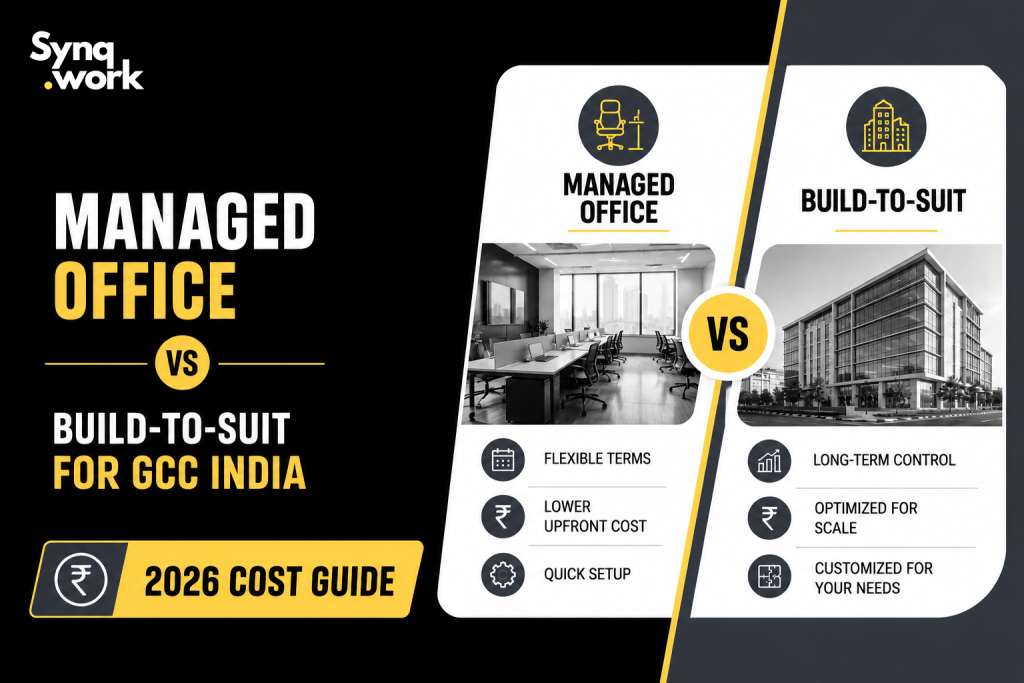
Two real estate models for GCCs entering India. One compresses setup to 60 days with zero CapEx. The other takes 9 to 18 months and locks up significant capital before a single employee sits down. Here is the honest comparison.
For GCCs under 500 seats, managed office wins on every metric that matters at launch: cost, speed, compliance readiness, and operational simplicity. Build-to-suit makes sense only for very large GCCs (500+ seats) with a confirmed 7 to 10-year tenure and an internal facilities management team already in place. SynqWork’s MO-GCC (Managed Office for Global Capability Center) is specifically built for this: private, enterprise-grade, fully managed GCC workspace operational in 60 to 90 days with zero upfront capital expenditure.
1. The Two Models: Managed Office vs Build-to-Suit
When a global enterprise sets up a GCC in India, the workspace decision is one of the highest-impact operational choices it makes. The two models dominating this decision in 2026 are managed office and build-to-suit. They differ on cost structure, timeline, risk profile, and the degree of operational burden the GCC leadership absorbs.
Managed Office for GCC (MO-GCC)
A managed office for a GCC is a private, enterprise-grade workspace built to the GCC’s specifications and managed end-to-end by a single provider like SynqWork. The GCC occupies a dedicated floor or building, branded to its standards, with its own IT network, security systems, and facilities. The provider handles everything: fit-out, IT infrastructure, security, housekeeping, pantry, cafeteria, and maintenance. The GCC pays one consolidated monthly fee per seat. Zero CapEx, zero vendor management, zero facilities staff to hire.
SynqWork’s MO-GCC service is this model applied specifically to Global Capability Centers: private, compliance-ready, enterprise-spec workspace operational in 60 to 90 days across New Delhi, Gurugram, Noida, Mumbai, and Chennai.
Build-to-Suit (BTS)
Build-to-suit involves the GCC negotiating a direct long-term lease on bare-shell or vanilla-shell commercial space from a landlord, then commissioning and managing its own fit-out, IT procurement, security installation, and facilities operations. The GCC entity owns the fit-out assets and is responsible for all operational overhead indefinitely. Full control, full cost, full operational burden.
Lease negotiation for Grade A GCC-spec space in Gurugram or Bengaluru takes 6 to 10 weeks. Interior design and tendering take another 4 to 8 weeks. Fit-out execution takes 16 to 24 weeks. IT infrastructure installation takes 4 to 6 weeks after fit-out. Fire safety and occupancy certifications take 4 to 8 additional weeks. Combined, a build-to-suit GCC is routinely 9 to 18 months from board approval to first occupancy. A MO-GCC is 60 to 90 days.
2. Full Comparison: 8 Dimensions
| Dimension | MO-GCC (Managed Office) | Build-to-Suit (BTS) |
|---|---|---|
| Setup Timeline | 60–90 days from engagement to first day of operations. | 9–18 months from lease signing to first occupancy. Every phase is sequential. |
| Upfront CapEx | Zero. No fit-out, no furniture, no IT hardware, no security installation. Deposit: 2–3 months. | High. Deposit 6–10 months. Fit-out Rs 2,000–4,500/sqft. Furniture, IT hardware, security installation — all separately procured and funded. |
| Monthly Cost Model | One all-inclusive per-seat fee. Fully predictable. No hidden additions. | Base rent + utilities + housekeeping + maintenance + pantry + IT management. Hidden operational costs add 30–40% above base rent. |
| Facilities Management | Zero overhead. Provider manages all operations end-to-end. | Full internal overhead. 8–15 separate vendor contracts. Internal FM team or manager required. |
| Customisation | Full. Floor plan, brand environment, IT spec, security protocols — all built to GCC’s requirements. | Full. Complete control over design and build. But the GCC project-manages everything itself. |
| Compliance Readiness | Delivered by provider: fire NOC, occupancy certificate, dedicated network perimeter, SOC2/ISO 27001 compatible physical security, documented access control audit trail. | GCC’s responsibility to obtain and maintain. Certifications can be delayed if build-out sequencing is not managed carefully. |
| Scalability | Built-in. Contiguous floors or warm shell buffers allocated at engagement. Expand without new lease negotiation. | Expansion requires new lease negotiation or subletting existing space. Lease lock-in creates inflexibility. |
| Best For | GCCs from 50 to 500+ seats. All tenures. Speed, compliance, and operational simplicity as priorities. | Very large GCCs (500+ seats). Confirmed 7–10 year tenure. Internal FM capability already in place. |
3. Cost Breakdown: Where the Numbers Land
The build-to-suit model appears cheaper per square foot on a base rent basis. That appearance does not survive contact with the total cost of occupancy calculation.
| Cost component | MO-GCC (Managed Office) | Build-to-Suit |
|---|---|---|
| Security deposit | 2–3 months (working capital recoverable) | 6–10 months (idle capital for lease lifetime) |
| Fit-out cost | Zero — included in monthly fee | Rs 2,000–4,500 per sq. ft. (basic to premium spec, Tier 1 city) |
| Furniture | Zero — included | Significant additional procurement and replacement overhead |
| Enterprise IT infrastructure | Zero — included (structured cabling, Wi-Fi, leased line, server room) | Separate procurement. Rs 800–1,500 per sq. ft. for enterprise spec. |
| Security systems | Zero — included (biometric, CCTV, visitor management) | Separate installation vendor and ongoing maintenance contract |
| Facilities management | Zero — included (housekeeping, pantry, cafeteria, reception) | Separate vendor contracts. Typically 8–15 vendors to manage. |
| Hidden operational costs | None — all-inclusive pricing | 30–40% above base rent (industry benchmark, 2026) |
| Setup timeline cost | 60–90 days. Leadership productive from week one. | 9–18 months of pre-operational overhead. GCC Head managing real estate instead of building a team. |
| First-year total cost (100 seats) | Baseline | Directionally 2.5x–3.5x higher than managed office on total first-year cost |
The hidden cost that no spreadsheet captures adequately is leadership bandwidth. A GCC Head managing a build-to-suit project for 9 to 18 months is not hiring engineers, not building the delivery model, and not establishing culture. That opportunity cost compounds: a team that could have been operational for 12 months generating value has instead been waiting for the building to be ready.
Build-to-suit’s per-seat rent advantage (typically 15 to 25% lower monthly rent than an equivalent managed office) becomes meaningful only when amortised over a 7 to 10-year lease. Before that breakeven point, the CapEx, deposit, and hidden operational cost premium of build-to-suit consistently outweigh the rent savings. For GCCs that expect to scale significantly — moving from 100 to 500 seats in 3 to 5 years — the managed office model’s built-in scalability eliminates another major BTS cost: re-leasing and re-fitting as headcount grows.
4. Risk Comparison: What Can Go Wrong
Cost comparisons look clean on paper. The risk profile of each model is where the decision becomes clearer.
Build-to-suit risks for GCCs:
- Fit-out delays. Contractor capacity constraints, material lead times, and landlord approval sequences routinely push BTS fit-out timelines by 2 to 4 months beyond plan. The GCC’s launch date slips. Leadership sits without a workspace while recruitment continues.
- Specification creep. Interior design revisions, upgraded IT specifications, and security system upgrades mid-project are common. Each revision adds cost and time. Final fit-out cost routinely exceeds initial budget by 15 to 30%.
- Compliance certification delays. Fire NOC, occupancy certificate, and electrical certification can be delayed by municipal backlogs. In some markets, these add 6 to 12 weeks to the timeline.
- Lease inflexibility. A 7-year lease signed for 200 seats becomes a liability if the GCC scales faster (needs more space mid-lease) or contracts (cannot exit without significant penalty).
- Vendor dependency. 8 to 15 vendors managing separate elements of operations creates single points of failure. One underperforming housekeeping vendor or one failed IT support contract affects the entire GCC environment.
MO-GCC managed office risks:
- Provider dependency. The GCC’s workspace quality is dependent on the provider’s service quality. Mitigated by SLAs, penalty clauses, and choosing a provider with an established track record.
- Higher monthly per-seat rate. Managed office carries a higher monthly fee than bare-shell BTS rent. For very large, stable teams on long tenures, this can add up over a 7 to 10-year horizon.
- Less physical control. The GCC does not own the fit-out assets. Modifications require provider coordination. Acceptable for most GCCs but relevant for those with highly specialised infrastructure requirements.
SynqWork operates as a single accountable partner with documented SLAs covering workspace uptime, IT infrastructure availability, facilities response times, and security protocols. All critical services (IT, security, facilities) are managed in-house rather than subcontracted out. This eliminates the vendor fragmentation risk that affects multi-provider BTS models and gives the GCC a single escalation point for every operational issue.
5. Which Model Is Right for Your GCC?
Choose MO-GCC (Managed Office) if:
- Your GCC is between 50 and 500 seats
- You need to go live in 60 to 90 days, not 18 months
- You want to deploy leadership bandwidth on hiring and delivery, not real estate project management
- You cannot or do not want to commit Rs 2,000 to 4,500 per sq. ft. in fit-out CapEx before the first employee joins
- Your GCC operates in a regulated sector (BFSI, healthcare, tech) requiring compliance-ready physical security from day one
- You expect headcount to grow significantly and need scalable infrastructure without re-leasing
- You are entering India for the first time and want predictable, consolidated OpEx rather than multi-vendor CapEx
Consider Build-to-Suit if:
- Your GCC will exceed 500 seats with stable headcount confirmed over a 7 to 10-year horizon
- You have an internal facilities management team already in place to run the space independently
- Your physical environment requirements are so specific that no managed provider can meet them
- The CapEx for fit-out and deposit does not constrain other strategic priorities
- You have the project management bandwidth to run a 9 to 18-month fit-out without diverting GCC leadership from the talent and delivery build
Most GCCs entering India in 2026 fall into the first category. Production-ready GCCs launched in 60 to 90 days rather than 12 to 18 months have become the benchmark expectation — because the talent competition means that a GCC waiting 18 months for its building is also waiting 18 months to hire. The market moves faster than BTS timelines allow.
How to set up a GCC in India: Complete 2026 guide (Blog 1) The 60-day GCC setup roadmap (Blog 2)6. FAQ
What is a managed office for GCC?
A managed office for a GCC (also called MO-GCC) is a private, fully managed, enterprise-grade workspace built to the GCC’s specifications and operated end-to-end by a single provider. The GCC occupies a dedicated floor or building, with its own brand environment, dedicated IT network, compliance-ready physical security, and full facilities management. The GCC pays one consolidated monthly fee per seat covering everything from fit-out to daily housekeeping. SynqWork’s MO-GCC service delivers this model across New Delhi, Gurugram, Faridabad, Mumbai, and Chennai with move-in timelines of 60 to 90 days and zero upfront CapEx.
Is managed office cheaper than building your own GCC office?
On a first-year total cost basis, managed office is significantly cheaper than build-to-suit. Build-to-suit requires a security deposit of 6 to 10 months of rent, fit-out costs of Rs 2,000 to 4,500 per sq. ft. depending on specification, furniture procurement, IT hardware, security installation, and 9 to 18 months of pre-operational overhead before the first employee sits down. Managed office has zero CapEx, a 2 to 3-month deposit, and all costs consolidated into one monthly fee. For GCCs under 500 seats, managed office delivers a lower total cost of ownership on a 3-year basis. Build-to-suit’s per-seat rent advantage only becomes meaningful over a 7 to 10-year lease for very large, stable teams.
How does build-to-suit GCC work in India?
Build-to-suit for a GCC involves negotiating a direct long-term lease on bare-shell or vanilla-shell commercial space, appointing an interior design and fit-out contractor, procuring furniture and IT infrastructure independently, engaging separate vendors for security, housekeeping, pantry, and facilities management, and obtaining fire safety and occupancy certifications. The process takes 9 to 18 months from lease signing to first occupancy. The GCC entity owns all fit-out assets and is responsible for all operational management indefinitely. It makes commercial sense for GCCs above 500 seats with a confirmed 7 to 10-year tenure and an internal FM team already in place. For most entering GCCs, a managed office model like SynqWork’s MO-GCC is the more cost-efficient and operationally sound choice.
What is plug-and-play GCC workspace?
Plug-and-play GCC workspace refers to a ready-to-occupy, fully fitted, enterprise-grade office where the GCC team can begin work from day one without any setup overhead. Furniture, IT infrastructure, networking, security, and facilities are all in place before the team arrives. SynqWork’s MO-GCC model is a plug-and-play GCC workspace built for enterprise requirements: private, branded, compliance-ready, with a dedicated network perimeter and documented security protocols compatible with SOC2 and ISO 27001. Unlike generic plug-and-play coworking, a MO-GCC is built specifically to the GCC’s specifications and compliance requirements, not a standardised shared environment.
GCC workspace from SynqWork — operational in 60 days
SynqWork’s MO-GCC service delivers private, enterprise-grade, fully managed GCC workspace across New Delhi, Gurugram, Faridabad, Mumbai, and Chennai. Zero CapEx. One monthly fee. 60 to 90-day go-live commitment.
Explore GCC workspace solutionsRelated reading
How
to set up a GCC in India: Complete 2026 guide (Blog 1)
The 60-day GCC setup roadmap (Blog 2)
GCC office space and managed workspace in India
Data sources and credits
- JLL India — GCC Office Guide 2026 (38% GCC share of office leasing, 31.3M sqft absorption)
- NASSCOM-Zinnov — GCC Landscape in India 2026 Report (2,117 GCCs, $100B revenue, 2.3M workforce)
- Cushman & Wakefield — India Office Fit-out Cost Guide 2025 (Rs 2,000–4,500/sqft fit-out range for GCC-spec space)
- ANAROCK — Flexible Workspace Report 2025 (30–40% hidden operational cost premium, 2.5x–3.5x Year 1 total cost premium for traditional office vs managed)
- CBRE-FICCI — Flex-plosion: India’s Flexible Workspaces Era, March 2026 (GCC flex demand, enterprise workspace data)
- Capax Global — Production-ready GCC timeline benchmark: 60–90 days vs 12–18 months for traditional captive models
- Esparkinfo — Cost of Setting Up a GCC in India 2026 (BOT and shared captive model cost-effectiveness for sub-500-seat GCCs)
- Industry standard — 6–10 months deposit range for Grade A commercial leases in Delhi NCR and Bengaluru, 2026
All data current as of May 2026. Cost figures are directional and vary by city, building grade, GCC specification, and team size. This guide is informational. Contact SynqWork for a tailored cost comparison for your GCC mandate.