A step-by-step guide to setting up a Global Capability Centre in India. Covers entity formation, office setup, IT, HR, and compliance — with 60-day go-live timelines.
India has over 2,100 GCCs generating close to $100 billion in revenue, with 2.3 million professionals on the ground. The old 12-to-18-month captive build is dead for most enterprises entering today. A Managed Office solutions for Global Capability Center (MO-GCC) puts your team at their desks in 60 to 90 days: compliant workspace, IT infrastructure, and facilities management, all handled by one accountable partner while your leadership focuses on hiring and capability building. This guide walks you through the entire process, step by step.
1. Why India, and why now
The math is no longer about labour arbitrage. India accounts for roughly 40% of the world’s GCC workforce, and the NASSCOM-Zinnov FY2026 report puts the total at 2,117 GCCs across 3,728 delivery units. That is a 32% increase since FY2021. The sector generates revenues approaching $100 billion and employs over 2.3 million professionals.
What changed in the last 18 months is the kind of work these centres do. 45% of India GCC output is now classified as expertise and frontier work, which means product engineering, AI model development, and global decision-making rather than transaction processing. 64% of GCC site leaders hold dual mandates, meaning they own a global business unit alongside running the India site. The talent that was hired to execute is now the talent that owns outcomes.
India also produces 2.5 million STEM graduates annually. Over 1,200 GCCs already have active AI and ML capabilities, and the country is the second-largest employer of enterprise AI talent globally. Operating costs run 30 to 50% lower than equivalent US or European operations, with the gap widest at junior levels (70 to 85% cost advantage) and still significant at senior levels (50 to 65%).
And then there is real estate. GCCs accounted for 38% of office leasing across India’s top seven cities in 2025, absorbing 31.3 million sq. ft. of Grade A space. The absorption number was the highest ever recorded. That is not a signal of a cooling market. For enterprises still deciding, the window to secure the best locations and the best people is narrowing.
Union Budget 2026 introduced a uniform 15.5% safe harbour margin for transfer pricing, raised the threshold from Rs 300 crore to Rs 2,000 crore (covering 1,000+ existing GCCs), and extended GIFT City’s tax holiday to 20 years. Karnataka, Maharashtra, Uttar Pradesh, Telangana, and Gujarat all have dedicated GCC policies with single-window clearances, payroll subsidies, and fast-track approvals.
2. The workspace model that matters: MO-GCC
Before anything gets filed with the MCA, you need to decide how your workspace will work. Entity structure, whether a Wholly Owned Subsidiary, a joint venture, or something lighter, is a legal and tax decision your counsel will advise on. The workspace decision is separate. And it is the one that determines whether your GCC is operational in 60 days or 12 months.
Most enterprises entering India lose 6 to 9 months on real estate alone: sourcing, negotiating, designing, tendering fit-out, procuring IT hardware, hiring facilities staff, managing vendors. That is 6 to 9 months where your GCC Head has no team at desks and no delivery to show the board.
A Managed Office solutions for Global Capability Center (MO-GCC), delivered by Synqwork, eliminates that entire cycle.
| Conventional lease + self-build | MO-GCC | |
|---|---|---|
| Timeline to occupancy | 9–18 months | 60–90 days |
| Upfront CapEx | Rs 2–10 Cr+ (fit-out, furniture, IT hardware) | Zero |
| Vendor management | 8–15 vendors (interiors, IT, security, housekeeping, pantry, MEP) | One partner, one contract |
| Scalability | Renegotiate lease, re-tender fit-out | Built-in expansion mechanisms (contiguous floors, warm shell buffers) |
| Commercial model | Lease deposit + CapEx + monthly OpEx across multiple line items | One consolidated monthly fee per seat (pure OpEx) |
| Leadership bandwidth consumed | High (3–6 months of GCC Head time on real estate) | Near zero (workspace is the partner’s problem) |
Synqwork’s MO-GCC (Managed Office solutions for Global Capability Center) is built specifically for GCCs: a private, enterprise-grade, fully managed workspace where Synqwork handles end-to-end operations, from fit-out to daily facilities. One monthly fee, zero CapEx, zero vendor management. The enterprise gets full control over floor plan, brand, network, and security. Synqwork manages everything else.
3. Step-by-step: GCC setup process in India
The process has six phases. With a MO-GCC partner handling the workspace, Steps 3 through 5 run in parallel rather than sequentially, which is what compresses the timeline from 12+ months to 60 to 90 days.
Define your mandate and operating model
Before any paperwork, answer three questions: what functions will this centre handle? Which city offers the best talent-cost balance for those functions? What is the three-year headcount target?
Centres that start with a vague “innovation hub” mandate without specific product ownership struggle to attract senior talent. Define clear P&L lines, reporting structures, and deliverables. Decide whether the India site will be a cost centre delivering services inward or a revenue centre with market-facing responsibilities.
This step also determines your entity structure, which is a legal and tax decision for your counsel. What matters on the workspace side: engage a MO-GCC partner early so office build-out runs in parallel with entity registration. You do not want your GCC Head waiting months for a desk.
Select your city
Each Indian metro has a specialisation profile. The choice should be driven by the function you are building, not just cost. (Detailed city-by-city breakdown in Section 8.)
Quick version: engineering and AI go to Bengaluru. BFSI analytics and pharma go to Hyderabad. R&D and automotive engineering go to Pune. Financial services, consulting, and back-office operations go to Delhi NCR. Software and automotive go to Chennai. Tier-2 cities like Ahmedabad, Coimbatore, and Kochi are gaining traction for cost-sensitive mandates.
Incorporate your legal entity
The standard structure for a GCC is a Private Limited Company registered under the Companies Act, 2013. You file through the SPICe+ (Simplified Proforma for Incorporating Company Electronically Plus) portal with the Ministry of Corporate Affairs.
What you need:
- Minimum two directors (at least one must be resident in India)
- Minimum two shareholders
- Digital Signature Certificates (DSC) for directors
- Director Identification Numbers (DIN)
- Registered office address in India
What gets filed and registered:
- SPICe+ with MCA (includes PAN, TAN allocation and GST registration)
- FDI receipt reported to RBI within 30 days via Form FC-GPR
- FEMA 1999 compliance documentation
- Annual RBI Foreign Liabilities and Assets (FLA) filing
- Provident Fund and Employee State Insurance registration
- State-level Shops and Establishments Act compliance
Entity registration itself takes 2 to 4 weeks. If you are running a MO-GCC model, workspace setup happens in parallel during this period. You do not wait for entity registration to complete before your office is being built.
Because a GCC provides services to its overseas parent, every inter-company transaction must be priced at arm’s length under Indian transfer pricing rules. The Union Budget 2026 safe harbour rules have simplified this considerably (15.5% uniform margin, Rs 2,000 Cr threshold), but documentation needs to be in place from the first invoice. Engage a qualified TP advisor before operations begin, not after the first audit notice.
Set up your workspace
This is the step where most GCC launches either accelerate or stall. The workspace decision has more operational impact than most leadership teams expect.
The full breakdown of the MOGCC approach is in Section 4 below.
Hire leadership and build the team
Start with the GCC Head, functional leaders, HR, and compliance advisors. Then scale engineering, analytics, or operations teams through structured recruitment. India’s GCC talent market is competitive. You are hiring from the same pool as Google, Microsoft, Amazon, and hundreds of other established GCCs.
A few hiring realities in 2026: AI and data-centric roles are the hardest to fill. Platform engineering, cloud architecture, SRE, and DevSecOps are expanding fast. Product managers with FAANG or high-growth startup experience are accessible but move quickly. Pre-engage recruitment partners during entity registration so you have a candidate pipeline ready the day your office opens.
Activate compliance and IT infrastructure
Set up secure IT infrastructure with enterprise-grade cybersecurity, cloud connectivity, and business continuity capabilities. For BFSI or healthcare GCCs operating under SOC2, ISO 27001, or GDPR frameworks, the compliance requirements extend to physical workspace: dedicated network perimeters, documented access controls, and auditable physical security.
Data compliance now includes the Digital Personal Data Protection (DPDP) Act, 2023 and the notified DPDP Rules, 2025. If your GCC processes personal data on behalf of the parent entity, you are a data processor under Indian law and need documented consent mechanisms, breach notification protocols, and data localisation procedures where applicable.
4. Workspace setup and the MOGCC model
Under a conventional lease, sourcing, negotiating, designing, and building a GCC office takes 9 to 18 months and significant upfront capital. The fit-out alone, furniture, networking, access control, power backup, fire compliance, can run Rs 2,500 to Rs 4,500 per sq. ft. depending on the city and specification.
Synqwork’s MO-GCC model compresses that entire cycle into a single engagement. Here is how it works:
What a MO-GCC partner delivers
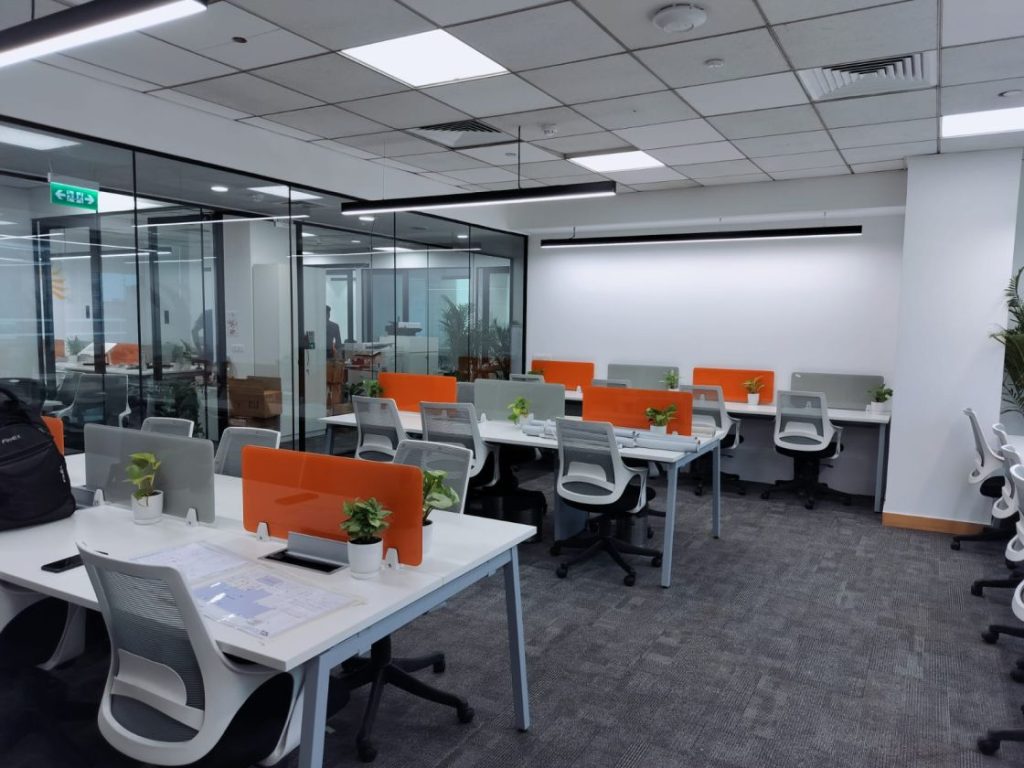
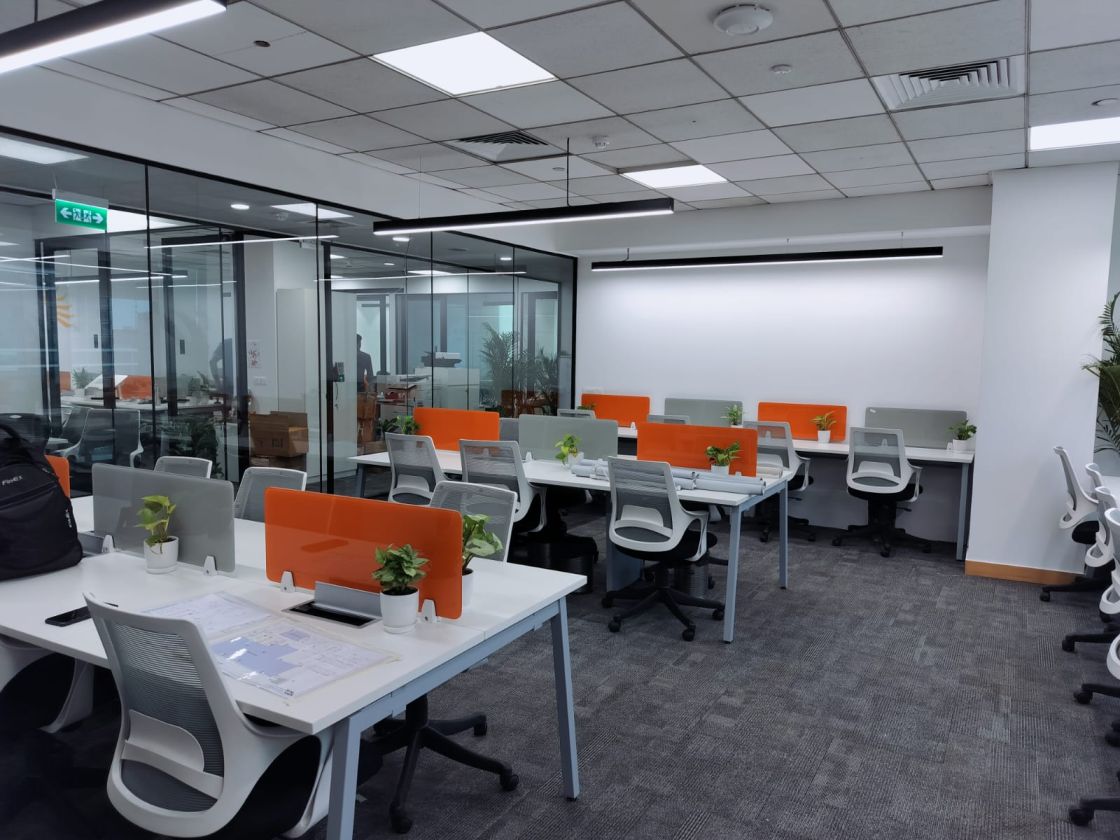
- Dedicated, branded workspace built to your floor plan, your brand guidelines, and your security requirements. This is not shared coworking. It is a private office operated for a single occupier.
- Enterprise-grade IT infrastructure: fibre connectivity, structured cabling, enterprise Wi-Fi, server rooms, UPS and DG backup, CCTV, biometric access control.
- Compliance-ready physical environment: dedicated network perimeter, visitor management, documented security protocols for SOC2, ISO 27001, and equivalent frameworks.
- Facilities management: housekeeping, pantry, cafeteria, reception, mail room, maintenance, all under one monthly fee.
- Scalability: built-in expansion mechanisms (contiguous floors, warm shell buffers) so you are not stuck renegotiating when headcount grows.
The economic model is pure OpEx. No capital expenditure on fit-out, furniture, or IT hardware. One consolidated monthly fee per seat. This matters for CFOs managing India entry as a phased investment rather than a single capital commitment.
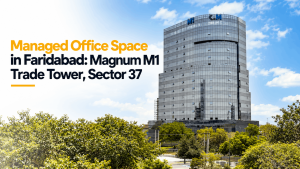
Synqwork provides fully managed offices and manages end-to-end operations for GCCs across New Delhi, Gurugram, Faridabad, Mumbai, and Chennai. Enterprise-grade Grade A workspace, fully customised to client specifications, operational in 60 days, with one accountable partner for the entire real estate and operations lifecycle. Pre-leased occupancy from day one. Zero CapEx. Zero vendor fragmentation. One monthly fee.
When does a GCC outgrow coworking?
Coworking works for pilot teams under 25 people with a horizon under 12 months. Once headcount crosses 40 to 50, or the mandate shifts from exploratory to permanent, the economics and compliance logic of a dedicated managed office become stronger. Specific triggers: a compliance or client security review raises questions about shared infrastructure, senior hires or client visits produce a first impression that does not match the company’s global standard, or the India presence has become a multi-year strategic commitment.
5. Compliance and regulatory checklist
This is the compressed version. Every item below needs to be addressed before or within the first 90 days of operations.
| Category | Requirement | When |
|---|---|---|
| Entity | Private Limited Company via SPICe+ (Companies Act 2013) | Week 1–4 |
| Tax | PAN, TAN, GST registration | With SPICe+ |
| FDI | RBI FDI receipt (Form FC-GPR), FEMA compliance | Within 30 days of FDI |
| Employment | EPF, ESI, Shops & Establishments Act (state-level) | Before first hire |
| Payroll | TDS processes, Professional Tax registration | Before first payroll |
| Data | DPDP Act 2023 + Rules 2025 compliance | Before data processing begins |
| Transfer pricing | TP documentation, arm’s length pricing, safe harbour election | Before first inter-company invoice |
| Annual | RBI FLA filing, ROC annual returns, tax audit | Ongoing |
| Sector-specific | STPI/SEZ registration (if applicable), industry-specific licenses | Based on mandate |
6. The 60-day go-live timeline
This timeline assumes a MO-GCC model with parallel execution. A captive build without a managed workspace partner adds 3 to 6 months on top of this for real estate procurement and fit-out.
Finalise GCC mandate, operating model, and city. Define headcount roadmap (day-one, 12-month, 24-month). Identify MO-GCC partner. Begin entity registration process.
SPICe+ filing underway. MO-GCC partner begins workspace customisation: floor plan, branding, IT infrastructure spec. Pre-engage recruitment partners to build candidate pipeline.
Entity registration and tax registrations complete. EPF, ESI, Shops & Establishments filed. Workspace fit-out reaches finishing stages. Leadership interviews in final rounds.
Enterprise IT infrastructure goes live: networking, cybersecurity, cloud connectivity. DPDP and transfer pricing documentation finalised. GCC Head and first functional leaders join.
First wave of hires onboarded. Workspace fully operational. Compliance audit trail documented. Delivery begins to parent company. Scale hiring continues.
7. What GCC setup actually costs in 2026
First-year costs vary enormously by model, city, and team size. Here are the ranges that matter:
| Cost component | Captive (self-build) | MOGCC model |
|---|---|---|
| Entity registration and legal | $50K–$150K | $50K–$150K (same) |
| Office fit-out and furniture | $200K–$800K | Included in monthly fee |
| IT infrastructure | $100K–$300K | Included in monthly fee |
| First-year salaries (30–50 engineers) | $500K–$2M | $500K–$2M (same) |
| Recruitment costs | $150K–$500K | $150K–$500K (same) |
| Workspace (annual, 50 seats) | Lease + OpEx: variable | ~Rs 15K–25K/seat/month all-in |
The real savings in the MO-GCC model are not just financial. It is the leadership bandwidth that does not get consumed by real estate procurement, vendor management, and facilities operations. A GCC head spending three months on fit-out approvals is a GCC head not building the engineering team.
Deep dive: GCC setup costs in India (Blog 6)8. City selection: matching the function to the market
| City | GCC share | Strengths | Typical mandates |
|---|---|---|---|
| Bengaluru | 35–40% | Deepest engineering pool, AI talent, mature ecosystem | Product engineering, AI/ML, cloud, R&D |
| Hyderabad | 20–23% | 20–30% cheaper than Bengaluru, strong pharma + BFSI | Analytics, BFSI operations, cloud platforms, pharma R&D |
| Pune | ~10% | Highest flex penetration nationally (14–16%) | R&D, automotive engineering, manufacturing tech |
| Delhi NCR | ~12% | Proximity to regulators, strong financial services pool | Financial services, consulting, back-office, GBS |
| Chennai | ~8% | Deep workforce, strong in automotive and software | Software development, automotive, R&D |
| Mumbai | ~7% | Financial capital, BFSI talent concentration | Financial services, risk, compliance, treasury |
Delhi NCR, where Synqwork has its deepest presence across New Delhi, Gurugram, and Faridabad, serves financial services, consulting, PSU, and back-office GCC mandates particularly well. The Gurgaon/Cyber City corridor offers Grade A commercial stock with proximity to Delhi airport, established GCC infrastructure, and a large talent pool in BFSI, GBS, and digital operations.
Ahmedabad, Coimbatore, Kochi, and similar cities offer 10 to 35% lower costs and lower attrition. They work for specific mandates: digital operations, customer experience, back-office processing. They do not yet have the senior engineering talent density for a 200-person AI team. Be honest about the function before choosing the city.
9. Five mistakes that delay GCC launches by six months
1. Starting workspace procurement after entity registration
Entity registration takes 2 to 4 weeks. Conventional fit-out takes 4 to 6 months. If you sequence them, you have leadership in place with nowhere to sit. A MO-GCC model runs both in parallel.
2. Underspecifying the mandate
“We’ll figure it out once we’re on the ground” is the most expensive sentence in GCC planning. Vague mandates attract vague talent. Define the first three product or process ownership areas before Day 1.
3. Ignoring transfer pricing until audit season
Transfer pricing documentation is not a Year 2 problem. It is a pre-launch problem. Get the arm’s length pricing, the benchmarking study, and the documentation framework in place before the first inter-company invoice is raised.
4. Treating workspace as a facilities problem instead of a strategic one
For a 200-person GCC, workspace represents the second-largest cost line after salaries. It also directly affects hiring competitiveness, employee retention, and client perception. The companies that treat workspace setup as an afterthought end up either in spaces that do not meet compliance standards, or in spaces that senior candidates walk away from after the first site visit.
5. Hiring the GCC Head last
The GCC Head should be involved in city selection, workspace design, and compliance planning, not brought in after those decisions are already locked. The best GCC leaders want ownership of the build, not just the operation.
FAQ
How do you set up a Global Capability Centre in India?
Six steps: define your mandate and city, incorporate a Private Limited Company via SPICe+, engage a MO-GCC partner to build your workspace in parallel, hire leadership and build the team, and activate compliance and IT infrastructure. With Synqwork’s MO-GCC model, the process takes 60 to 90 days from decision to operational status.
What is the process to establish a GCC?
Strategic planning (mandate, city selection), entity formation (SPICe+ filing, PAN/TAN/GST, RBI declarations), workspace setup through a MO-GCC partner, leadership hiring (GCC Head, functional leads, HR, compliance), team scaling, and compliance activation (DPDP, transfer pricing, employment law). The MO-GCC model runs workspace build-out in parallel with entity registration, which is what compresses the timeline to 60 to 90 days.
What are the legal requirements to set up a GCC in India?
Incorporate a Private Limited Company under the Companies Act 2013. Obtain PAN, TAN, GST registration. File FDI receipt with RBI within 30 days (Form FC-GPR). Annual RBI FLA filing. Comply with the Code on Wages and Code on Social Security. DPDP Act 2023 compliance for data processing. Transfer pricing documentation for inter-company transactions. Engage a qualified legal advisor since requirements vary by state, sector, and entity structure.
How long does GCC setup take in India?
A conventional self-build (entity + lease + fit-out) takes 12 to 18 months. Synqwork’s MO-GCC model compresses this to 60 to 90 days by running entity registration, workspace build-out, and talent pipeline development in parallel. The workspace itself is move-in ready within 60 days of engagement.
What is Synqwork?
Synqwork is an enterprise managed office platform that provides fully managed offices and manages end-to-end operations for Global Capability Centers, Fortune 500 companies, and public sector undertakings across India. The company is present in New Delhi, Gurugram, Faridabad, Mumbai, and Chennai, serving 45+ clients across approximately 6,400 seats, with a client mix that includes unicorns, listed corporates, GCCs, MNCs, and SMEs. Synqwork is not a coworking brand. It is an enterprise infrastructure partner that takes full ownership of workspace operations so the client does not have to. Every workspace is private, branded to the client’s specifications, and managed end-to-end by Synqwork under a single contract.
What is MO-GCC? How does Synqwork deliver it?
MO-GCC (Managed Office for Global Capability Center) is Synqwork’s core service for global enterprises setting up or scaling GCCs in India. Synqwork delivers a private, fully managed, enterprise-grade workspace built to the occupier’s specifications and operates the entire facility end-to-end as a single accountable partner. This includes fit-out, enterprise IT infrastructure, physical security, access control, facilities management, housekeeping, pantry, cafeteria, reception, and day-to-day operations. One consolidated monthly fee covers everything from design to housekeeping, with zero upfront capital expenditure. No deposit locks. No multi-vendor coordination. No facilities team to hire.
Synqwork delivers MO-GCC across New Delhi, Gurugram, Faridabad, Mumbai, and Chennai with pre-leased occupancy from day one. The enterprise controls its floor plan, brand environment, network architecture, and security configuration. Synqwork manages every operational layer underneath, from landlord negotiation and fit-out execution to cafeteria operations and visitor protocols, so the client’s leadership team can dedicate 100% of its bandwidth to hiring, capability building, and delivery from the first week.
Set up your GCC with Synqwork
Fully managed offices across New Delhi, Gurugram, Faridabad, Mumbai, and Chennai. MO-GCC: end-to-end operations, customised to your spec, operational in 60 days. One partner, one fee, zero CapEx.
Explore GCC office spaceRelated reading
How much does it cost to set up a GCC in India? (Blog 6)
GCC office space and managed workspace in India
Data sources and credits
The statistics, market data, and regulatory information cited in this guide are drawn from the following sources:
- NASSCOM-Zinnov — GCC Landscape in India 2026 Report (FY2026 data: 2,117 GCCs, 3,728 units, workforce and revenue figures)
- CBRE-FICCI — Flex-plosion Report, March 2026 (office leasing absorption, flex demand share)
- JLL India — GCC Office Guide 2026 (31.3M sq. ft. absorption, 2030 projections, city-wise GCC distribution)
- Knight Frank — H2 2025 India Office Market Report (Grade A stock and flex penetration data)
- Vision IAS / NASSCOM — GCC milestone coverage, May 2026 (2,117 count, $100B revenue, 2.3M workforce, AI/ML capability data)
- KAS Business Consulting — India GCC Landscape Report 2026 Edition (GCC maturity stages, policy and budget data)
- Wisemonk India Investment Intelligence 2026 — Cost benchmarks, talent cost advantages, policy framework data
- Union Budget 2026 — Safe harbour margin (15.5%), threshold (Rs 2,000 Cr), GIFT City extension
- State GCC Policies — Karnataka (Nov 2024), Maharashtra (2025), Uttar Pradesh (2024), Telangana, Gujarat
- Companies Act 2013, FEMA 1999, DPDP Act 2023 — Legal and compliance framework references
All data is current as of May 2026. Specific figures may have been updated since publication. For the latest GCC workspace solutions and pricing, contact Synqwork directly.