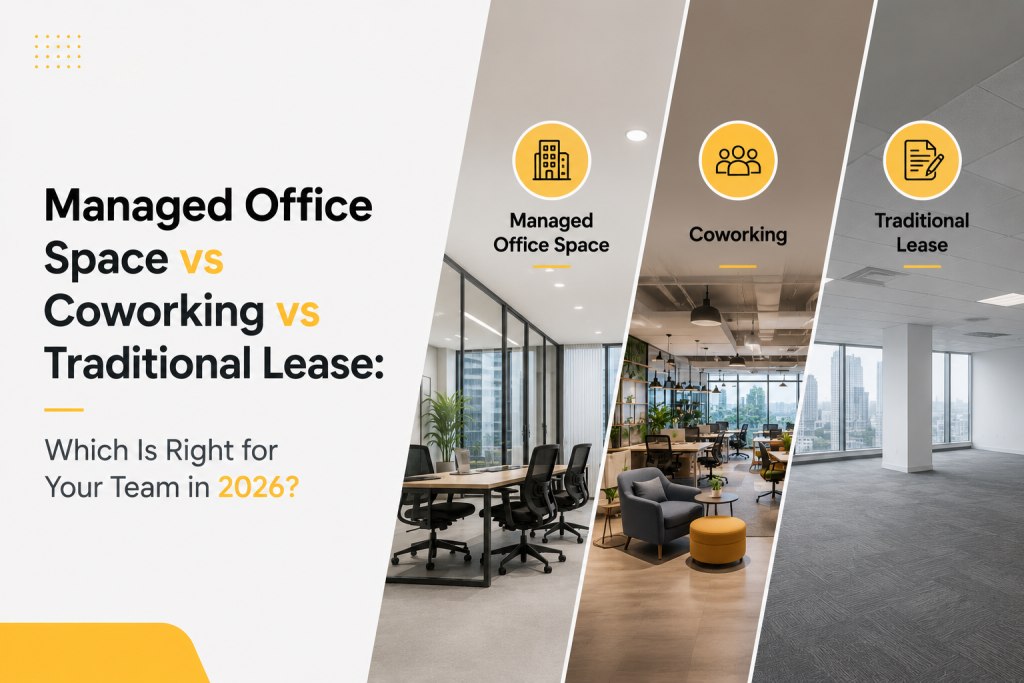
Three models dominate India’s office landscape in 2026. The one you choose affects your cost, your compliance position, your brand, and how fast you can move in. Here is the honest comparison.
A traditional lease looks cheapest per square foot. It is not cheapest by any measure that matters. Security deposits run 6 to 10 months of rent. Fit-out costs Rs 2,000 to 3,500 per sq. ft. Hidden operational costs add 30 to 40% on top of base rent. Total Year 1 cost is 2.8x to 3.5x a managed office (ANAROCK 2025). Coworking works for teams under 15 to 20 people. A managed office is the right model for enterprise teams: private, compliant, branded, zero CapEx, one all-inclusive monthly fee. For GCCs specifically, Synqwork’s MO-GCC is built for this.
What Is a Managed Office?
A private, dedicated workspace built to one occupier’s specifications and managed end-to-end by a provider. Your brand, your floor plan, your network, your access control. The provider handles fit-out, IT infrastructure, facilities, and daily operations under one consolidated monthly fee. Zero CapEx.
A managed office space is not coworking with a door on it. It is a completely different product. The space is exclusively yours — no other company shares your floor, your meeting rooms, your network, or your security perimeter. It is customised to your specifications: your brand environment, your floor plan, your IT architecture, your access control protocols. And it is managed end-to-end by the provider so your team focuses entirely on work, not on managing a building.
The commercial model is the key differentiator from a traditional lease. Instead of a large security deposit, fit-out capital expenditure, furniture purchases, IT hardware, and separate vendor contracts for housekeeping, pantry, security, and maintenance, there is one consolidated monthly fee per seat. Fully predictable. No hidden additions. No vendor management overhead.
What a managed office includes:
- Customised fit-out built to the occupier’s brand and functional specifications
- Enterprise IT infrastructure: structured cabling, enterprise Wi-Fi, leased line, UPS and DG backup
- Physical security: biometric access control, CCTV, visitor management, dedicated network perimeter
- Facilities: housekeeping, pantry, cafeteria, reception, maintenance, waste management
- Fire safety, electrical certification, and building compliance
- Built-in scalability: expansion through contiguous floors or warm shell buffers
Synqwork’s MO-GCC (Managed Office for Global Capability Center) is built specifically for GCCs and enterprise teams. Synqwork provides fully managed offices and manages end-to-end operations across New Delhi, Gurugram, Faridabad, Mumbai, and Chennai. Private, branded, enterprise-spec workspace, operational in 60 days, with one monthly fee covering everything from fit-out to daily housekeeping.
What Is a Coworking Space?
A shared workspace where multiple companies and individuals work alongside each other. Members access shared desks, meeting rooms, and facilities on flexible monthly commitments. No customisation, shared network, standardised environment.
Coworking solves a real problem for the right team: no fit-out, no long-term commitment, no facilities overhead, immediate occupancy. The flexibility is genuine and valuable. For freelancers, early-stage startups, and small teams under 15 to 20 people, coworking is a sensible default.
The model shows structural limits as teams grow. Past 25 people, the per-seat cost of private cabins and dedicated suites in a coworking space begins to approach managed office pricing, without the privacy, network security, or compliance capabilities a managed office provides. The shared network is a compliance concern for any team handling sensitive data. Meeting room credits become a bottleneck at team sizes that once found them more than adequate.
What Is a Traditional Office Lease?
A direct lease of bare-shell or semi-furnished commercial space from a landlord. The occupier handles design, fit-out, furniture, IT, and all facilities management independently. Lease terms run 3 to 9 years. Security deposits run 6 to 10 months of rent. Full control, full cost, full operational burden.
A traditional lease gives maximum physical control. You design every inch, you choose every vendor, and you own the furniture. For very large organisations with stable headcount above 500 people on a 7 to 10-year horizon and an internal facilities management capability, a direct lease can offer the lowest per-seat ongoing cost.
For most enterprises entering a new city, setting up a GCC, or scaling a satellite office, the traditional lease model is a capital and time trap. The security deposit locks up 6 to 10 months of rent as idle capital for the lease lifetime. Fit-out takes 6 to 9 months before a single employee sits down. Hidden operational costs add 30 to 40% to the headline rent figure. And the lease lock-in means a 3-to-9-year commitment on a decision that a growing team will outgrow.
Full Comparison Table: Managed vs Coworking vs Traditional Lease
| Dimension | Managed Office | Coworking | Traditional Lease |
|---|---|---|---|
| Privacy | 100% private. Dedicated floor, dedicated network, no shared access whatsoever. | Shared environment. Private cabins available but common areas, reception, and Wi-Fi are shared. | 100% private. Full physical control over the space. |
| Upfront Cost | Zero CapEx. 2–3 months deposit. No fit-out, furniture, or IT hardware purchase. | Near zero. 2 months deposit. No setup cost. | High. 6–10 months deposit + Rs 2,000–3,500/sqft fit-out + furniture + IT infrastructure. |
| Setup Time | 60–90 days for custom build. Pre-provisioned options in 2–4 weeks. | 1–2 weeks. Immediate move-in. | 9–18 months. Lease negotiation + fit-out + IT installation + certifications. |
| Monthly Cost Model | One all-inclusive per-seat fee. Fully predictable. No hidden additions. | Per-desk or per-suite. Meeting rooms often charged separately. Scales poorly past 25 seats. | Base rent + utilities + housekeeping + maintenance + pantry + IT + facilities management. Multiple separate vendor invoices. |
| Branding and Customisation | Full. Built to your brand, floor plan, IT spec, and security requirements. | None to minimal. Standardised provider environment shared with other companies. | Full. You design and build everything yourself at your own cost and timeline. |
| Scalability | Built-in expansion through contiguous floors and warm shell buffers. No new lease negotiation needed. | Easy to add individual desks. Harder to maintain privacy and brand environment at scale. | Expansion requires new lease negotiation or subletting existing space. Structurally inflexible. |
| Team Size Fit | 30 to 500 seats. Optimal for mid-to-large enterprise teams and GCCs. | 1 to 20 people. Best for small, flexible, or pilot teams. | 500+ seats on a long horizon. Requires internal FM team to operate efficiently. |
| Best For | GCCs, enterprise satellite offices, compliance-sensitive teams, branded environments, fast setup. | Freelancers, early-stage startups, pilot teams, small remote offices in new cities. | Very large, stable, long-tenured occupiers with internal facilities capability and CapEx budget. |
When Should You Choose a Managed Office Space?
A managed office space is the right choice when:
- Your team is between 15 and 500 seats and is expected to remain for 18 months or more
- You need a private, branded workspace that reflects your company’s professional standards from Day 1
- Compliance requirements demand a dedicated network, documented access control, and auditable physical security (BFSI, GCC, healthcare, legal, tech)
- You want to move in within 60 to 90 days without building anything from scratch
- You want one monthly fee with zero vendor management across 8 to 15 separate service providers
- You are executing a satellite office strategy across multiple cities and need a consistent enterprise-grade environment in each
- You are setting up a GCC and need a workspace that is compliant, scalable, and operational before your first hire joins
When Should You Choose Coworking?
Coworking makes sense when your team is small and your timeline is uncertain:
- Team size is under 10 people and the function is non-sensitive
- You are testing a new city or market before committing to a permanent presence
- The function does not require a dedicated network, physical security protocols, or branded environment
- Month-to-month flexibility is a higher priority than privacy, customisation, or compliance alignment
- Networking with other companies in the coworking community has genuine strategic value for your stage
When Should You Choose a Traditional Lease?
A traditional lease only makes structural sense in a narrow set of conditions:
- Headcount is stable at 500+ on a confirmed 7 to 10-year horizon in the same location
- The organisation has an internal facilities management team capable of running the space independently
- The CapEx for fit-out and deposit does not constrain other business priorities
- The physical environment requirements are so specific and proprietary that no managed provider can match them
Outside these conditions, the per-seat rent saving of a traditional lease does not outweigh the deposit, fit-out cost, setup timeline, and ongoing operational complexity. For most enterprises in India in 2026, a managed office delivers better outcomes on total cost, speed, and flexibility.
Cost Comparison: 3-Year Total Cost of Ownership
The per-square-foot rent figure that gets quoted in broker proposals is not the relevant cost metric. Total cost of occupancy — including deposit, fit-out, IT, facilities, and hidden operational costs — is what determines which model actually costs less over a realistic planning horizon.
| Cost component (50-seat team) | Managed Office | Coworking | Traditional Lease |
|---|---|---|---|
| Security deposit | 2–3 months | 2 months | 6–10 months (idle capital) |
| Fit-out and interiors | Zero — included | Zero | Rs 2,000–3,500 per sq. ft. |
| Furniture | Zero — included | Zero | Significant additional CapEx |
| Enterprise IT infrastructure | Zero — included | Shared Wi-Fi only | Leased line, cabling, switches, server room — multiple separate vendors |
| Housekeeping and maintenance | Included | Shared, included | Separate vendor contracts, monthly overhead |
| Pantry and cafeteria | Included | Sometimes included | Separate setup, separate vendor, ongoing management |
| Hidden operational costs | None — all-inclusive pricing | Low | 30–40% above base rent (industry data, 2026) |
| GST on rent | 18% on fee (where applicable) | 18% on membership | 18% on commercial rent monthly |
| 3-year TCO vs managed office | Baseline | Comparable for small teams. Higher past 25 seats. | 2.8x to 3.5x higher in Year 1. Narrows over 7+ years only at 500+ seats. |
Industry data for 2026 puts hidden operational costs in a traditional office at 30 to 40% above base rent, before accounting for the security deposit’s opportunity cost and the 18% GST on commercial rent. The ANAROCK Flexible Workspace Report 2025 found the total first-year cost of a traditional office is 2.8x to 3.5x higher than an equivalent managed office for most SMBs and enterprises. The managed office’s all-inclusive monthly fee, while higher per sq. ft. than headline rent, is the lower total cost option for the vast majority of teams between 30 and 500 seats.
FAQ: Managed Office Space vs Coworking vs Traditional Lease
What is the difference between managed office space and coworking space?
A managed office space is a private, dedicated workspace built and operated exclusively for one occupier — your brand, your floor plan, your network, your physical security. A coworking space is a shared environment where multiple companies and individuals work alongside each other, sharing desks, meeting rooms, Wi-Fi, and common areas. The core differences are privacy (managed office is 100% dedicated; coworking is shared), network security (managed office has a dedicated perimeter; coworking uses shared Wi-Fi), customisation (managed office is built to your spec; coworking is standardised), and compliance compatibility (managed office can support SOC2, ISO 27001, and equivalent physical security frameworks; coworking typically cannot). For teams above 25 to 30 people, a managed office typically offers better value and compliance alignment than coworking, even on a per-seat cost basis.
Is managed office better than coworking for a team of 30?
Yes, for most teams of 30. At that size, coworking costs for private cabins and dedicated suites begin to approach managed office pricing once dedicated desks, meeting room credits, and storage are factored in — without the privacy, compliance capability, or brand environment that a managed office provides. A managed office at 30 seats adds a dedicated network perimeter, branded environment, biometric access control with audit trail, and physical security documentation that supports compliance audits. For GCCs, BFSI teams, or any organisation handling sensitive data, a shared coworking network is a compliance concern that makes the model unsuitable regardless of per-seat pricing. Coworking is most appropriate for teams under 15 to 20 people with a flexible timeline and low compliance requirements.
Which is cheaper: managed office or traditional lease?
The managed office is cheaper on a total cost of occupancy basis for most teams. A traditional lease’s headline rent looks lower per sq. ft., but the complete first-year picture includes a security deposit of 6 to 10 months of rent, fit-out costs of Rs 2,000 to 3,500 per sq. ft., furniture and IT hardware purchases, and hidden operational costs that add 30 to 40% on top of base rent. The ANAROCK Flexible Workspace Report 2025 found the total first-year cost of a traditional office is 2.8x to 3.5x higher than an equivalent managed office for most enterprises. A managed office has zero CapEx, a 2 to 3 month deposit, no fit-out, and one all-inclusive monthly fee. The traditional lease only wins on per-seat cost for very large, stable teams (500+ seats) on a 7+ year horizon.
What is the 3-year total cost of ownership for managed office vs traditional lease?
For a 50-seat team, the managed office delivers a lower 3-year TCO than a traditional lease when all costs are included. The managed office advantage comes from zero fit-out CapEx versus Rs 2,000 to 3,500 per sq. ft. for the traditional lease, a 2 to 3 month deposit versus 6 to 10 months of idle capital, one all-inclusive monthly fee versus rent plus 30 to 40% hidden operational costs, and zero vendor management versus 8 to 15 separate service contracts. The traditional lease only becomes more economical past 500+ seats on a 7+ year horizon where per-seat rent economies outweigh the setup and operational overhead. For GCCs and enterprise teams in the 30 to 500 seat range, the managed office is the lower total cost model on a 3-year view.
See why 100+ teams chose Synqwork managed office over coworking
Private, branded, enterprise-grade managed offices across New Delhi, Gurugram, Faridabad, Mumbai, and Chennai. End-to-end operations, zero CapEx, one monthly fee. Book a visit and see the difference.
Book a visitRelated reading
How to set up a GCC in India: Complete 2026 guide (Blog 1)
GCC vs outsourcing vs ODC: which delivery model wins? (Blog 4)
GCC setup costs in India (Blog 6)
Synqwork managed office space
Data sources and credits
- ANAROCK — Flexible Workspace Report 2025 (2.8x–3.5x Year 1 cost premium for traditional lease vs managed office)
- Cushman & Wakefield — India Office Fit-out Cost Guide 2025 (Rs 2,000–3,500/sqft fit-out benchmark)
- Flex workspace market research, 2026 — Leasing vs coworking cost benchmarks: hidden costs 30–40% above base rent, sourced from published industry reports
- Commercial real estate advisory benchmarks, 2026 — Traditional office deposit range (6–10 months), 18% GST on commercial rent, total occupancy cost analysis
- Flexible workspace cost analysis, 2026 — Managed office vs traditional leasing cost comparison: 25–30% total cost savings with managed model, from published industry research
- Enterprise workspace industry research, 2026 — Managed office model definitions, team size fit benchmarks, and provider selection criteria from published market reports
- CBRE-FICCI — Flex-plosion Report, March 2026 (managed flex demand, GCC absorption data)
- Indian GST framework — 18% GST on commercial rent
All data current as of May 2026. Costs vary by city, building grade, team size, and specification level. This guide is informational. Contact Synqwork for a tailored workspace assessment.