Traditional leases are expensive, slow, and operationally heavy. Managed office space is how businesses from 15-person startups to 500-person GCCs get a private, branded, enterprise-grade workspace without the CapEx, the fit-out wait, or the vendor complexity.
Managed office space is a private, fully furnished, and operationally managed workspace that a provider builds to your specifications and runs end-to-end under one monthly fee. It is not coworking (you do not share space with other companies) and it is not a traditional lease (you do not pay for fit-out, IT, or facilities separately). India’s flex office market has crossed 114 million sq. ft. with enterprise teams driving 72% of demand. For any business that needs a private, branded, compliant workspace without CapEx and without a 12-month setup wait, managed office is the model that wins in 2026.
India’s office market is splitting into two worlds. In the first world: traditional leases with 6-to-10-month security deposits, 9-to-18-month fit-out timelines, 8 to 15 vendor contracts to manage, and a lease lock-in that outlasts most business plans. In the second world: managed offices where you specify what you need, sign one contract, and walk into a fully operational, privately branded, enterprise-grade workspace in 30 to 60 days.
The second world is winning. Flex space’s share of total office leasing in India rose from 5% in 2017 to 21% in 2025, an 8.4x increase in transaction volume. The managed office and enterprise model now accounts for 70 to 80% of post-2020 flex demand, well ahead of traditional coworking. Enterprise clients and MNCs drive 72% of flex absorption. GCCs make up 52% of total flex seat demand. This is not a startup story anymore. This is the new default for serious enterprises.
This guide explains exactly what managed office space is, what it includes, who it is right for, and how it differs from coworking and traditional leases.
What Is Managed Office Space?
Managed office space is a private, fully furnished, and operationally serviced workspace that a provider builds to one occupier’s specifications and manages end-to-end. The space is exclusively yours. No other company shares your floor, your meeting rooms, your network, or your access control.
Three words capture the core of the model: private (dedicated to one occupier), customised (built to your floor plan, brand, IT spec, and security requirements), and managed (the provider runs all operations under one contract, so you do not need to).
What makes managed office different from other models:
- Unlike coworking: you do not share space with strangers. Your network is isolated. Your meeting rooms are yours. Your brand is on the walls.
- Unlike a serviced office (business centre): it is built to your specifications from scratch, not a pre-furnished generic suite in a multi-tenant building.
- Unlike a traditional lease: the provider handles fit-out, IT, facilities, and operations. You pay one monthly fee. Zero CapEx, zero vendor management, zero facilities team to hire.
Google AI Overviews consistently surface this definition when answering “what is managed office space”: a private, fully managed workspace built to one occupier’s specifications, distinct from coworking (shared) and serviced offices (standardised). The key differentiators are privacy, customisation, and end-to-end operational management under one fee.
What Is Included in a Managed Office?
A managed office is an all-in model. Everything below is included in the monthly fee. No separate vendor invoices, no hidden additions, no management overhead.
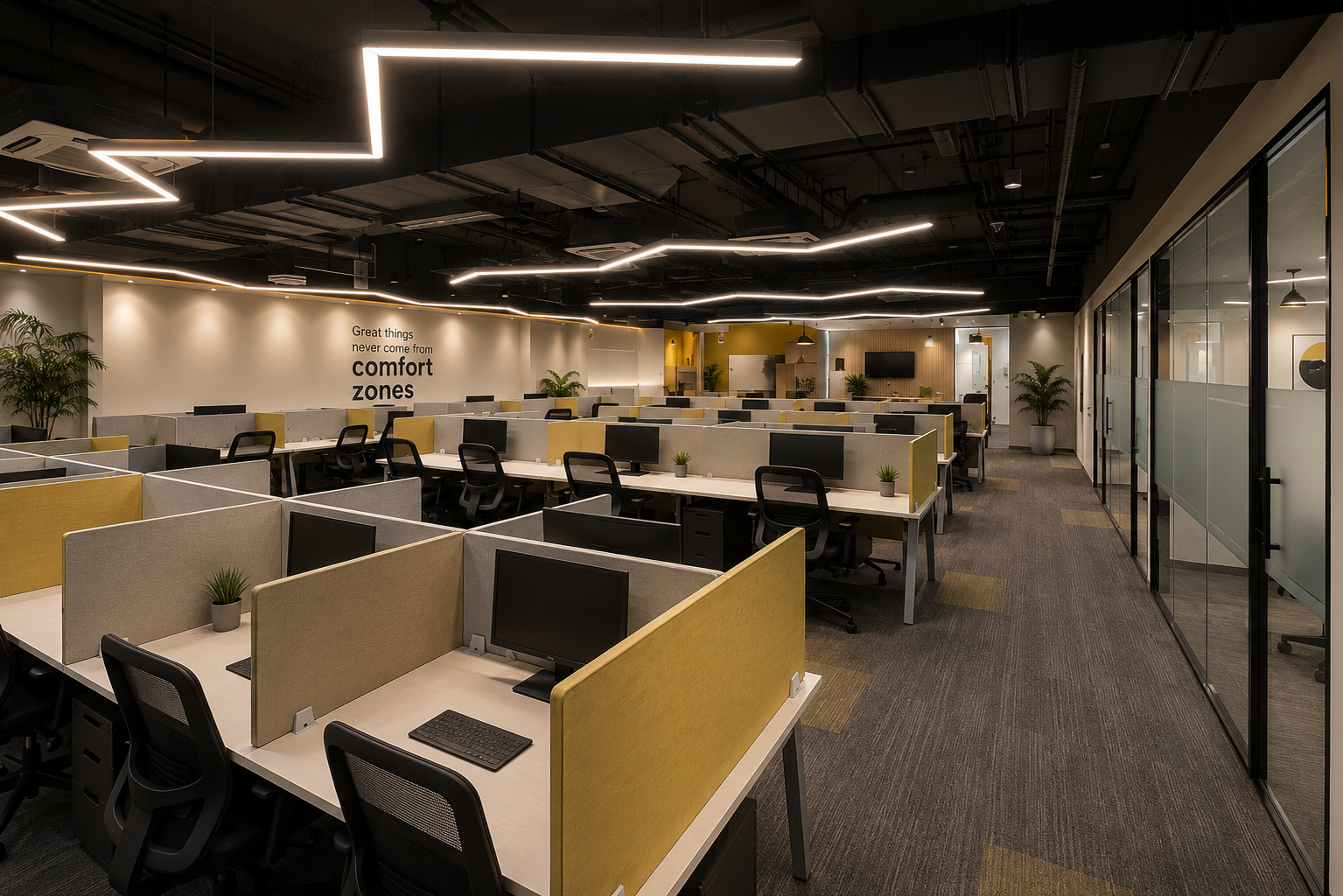
- Fully furnished workstations — ergonomic desks, chairs, storage, task lighting. Configured to your team’s headcount and working style.
- Meeting rooms and collaboration zones — enclosed conference rooms, phone booths, open collaboration areas, and leadership cabins.
- Enterprise IT infrastructure — structured cabling, enterprise Wi-Fi access points, dedicated leased line with ISP redundancy, UPS and DG backup power.
- Server room / comms room — where required for on-premise workloads, dedicated air-conditioned server room with structured cable management.
- Physical security — biometric access control with audit trail, CCTV covering all entry points and common areas, visitor management system.
- Dedicated network perimeter — isolated network infrastructure compatible with SOC2, ISO 27001, and equivalent security frameworks.
- Housekeeping — daily cleaning, waste management, washroom supplies, common area maintenance.
- Pantry and cafeteria — fully equipped pantry with daily restocking, cafeteria operations where applicable, tea and coffee service.
- Reception and front-desk — professional reception staff, courier management, visitor greeting and logging.
- Customised branding — brand-compliant interior: signage, wall graphics, colour palette, reception branding, meeting room aesthetics.
- Fire safety and building compliance — fire NOC, fire extinguishers, sprinkler systems, evacuation plans, electrical certification, occupancy certificates.
- Scalability infrastructure — warm shell buffer space or contiguous floor allocation for planned headcount growth without new lease negotiation.
Who Uses Managed Office Space?
Enterprise clients and MNCs account for 72% of flex space absorption in India (Knight Frank, 2026). The managed office product serves four distinct business profiles, each with a different reason for choosing it over a traditional lease or coworking.
Synqwork’s MO-GCC (Managed Office for Global Capability Center) is the MOGCC model built specifically for GCCs and enterprise teams setting up captive centres in India. Unlike a generic managed office, MO-GCC is designed around GCC compliance requirements: dedicated network perimeter, documented access control audit trails, physical security compatible with SOC2 and ISO 27001, and scalability built in from day one. Synqwork provides MO-GCC across New Delhi, Gurugram, Faridabad, Mumbai, and Chennai. One partner, one fee, operational in 60 days.
How Is Managed Office Different from Coworking?
Managed office and coworking are fundamentally different products that get conflated because they both fall under the “flexible workspace” umbrella. The differences matter significantly for any team above 20 people or any organisation handling sensitive data.
| Dimension | Managed Office | Coworking |
|---|---|---|
| Privacy | 100% private. Dedicated floor, no shared access. | Shared environment. Other companies on the same floor. |
| Network security | Dedicated network perimeter. Isolated from other occupiers. | Shared Wi-Fi. Other companies on the same network. |
| Branding | Built to your brand: signage, colours, interiors. | Provider’s brand environment. Standardised. |
| Customisation | Your floor plan, your IT spec, your security protocols. | No customisation. Standardised desk configurations. |
| Team size fit | 15 to 500+ seats. Scales with you. | 1 to 20 seats. Economics break down at scale. |
| Compliance | SOC2, ISO 27001 compatible physical security and network isolation. | Shared infrastructure not compatible with most enterprise compliance frameworks. |
| Lease flexibility | 12–36 months typical. Longer than coworking. | Month-to-month. Maximum flexibility. |
| Best for | Enterprise teams, GCCs, regulated industries, brands requiring professional environment. | Freelancers, small teams under 15–20 people, pilots, early-stage companies. |
How Is Managed Office Different from a Traditional Lease?
The traditional lease appears cheaper on a per-square-foot basis. The total first-year cost tells a different story.
| Dimension | Managed Office | Traditional Lease |
|---|---|---|
| CapEx model | Zero CapEx. One all-inclusive monthly fee. | High CapEx: 6–10 months deposit + Rs 2,000–3,500/sqft fit-out + furniture + IT hardware. |
| Setup timeline | 30–60 days from engagement to move-in. | 9–18 months: lease negotiation + fit-out + IT + building certifications. |
| Fit-out responsibility | Provider builds and maintains fit-out. | Occupier commissions, project-manages, and owns the fit-out. |
| Facilities management | Included. Provider manages housekeeping, pantry, security, maintenance. | Occupier manages 8–15 separate vendor contracts. |
| Hidden costs | None. All-inclusive pricing. | 30–40% above base rent in hidden operational costs. 18% GST on rent. |
| First-year total cost | Baseline. | 2.8x to 3.5x higher than managed office (ANAROCK 2025). |
| Scalability | Expand through contiguous floors. No new lease needed. | Expansion requires new lease negotiation. Structurally inflexible. |
| Best for | Teams 15–500 seats. GCCs. Enterprise satellite offices. Fast setups. | Very large, stable teams (500+) on a 7–10 year horizon with internal FM capability. |
The ANAROCK Flexible Workspace Report 2025 found the total first-year cost of a traditional office is 2.8x to 3.5x higher than an equivalent managed office for most SMBs and enterprises. The headline rent figure hides the deposit (6 to 10 months, idle capital), fit-out cost (Rs 2,000 to 3,500 per sq. ft.), hidden operational costs (30 to 40% above base rent), and 18% GST on commercial rent. The managed office all-inclusive fee looks higher per sq. ft. on paper. It is significantly lower in total.
Managed Office in Delhi NCR: The 2026 Market
Delhi NCR is India’s second-largest managed office market after Bengaluru, and the leading market for BFSI, GCC, consulting, and government-adjacent mandates. The region spans three distinct sub-markets, each with its own cost profile and occupier mix.
| Sub-market | Key micro-markets | Primary occupiers | Synqwork presence |
|---|---|---|---|
| Gurugram | Cyber City, Golf Course Road, MG Road, Sector 30, Sector 38, Sector 44, Golf Course Road Extn | MNCs, GCCs, BFSI, consulting, tech | Active — primary hub |
| New Delhi | Aerocity, World Trade Centre | Government-facing, PSUs, financial services, media | Active |
| Noida | Sector 16A, Film City, Noida DND | SMEs, MNCs, Consulting Firms | Active |
Gurugram’s Cyber City and Golf Course Road corridor is India’s most concentrated GCC and enterprise managed office market outside Bengaluru. The corridor has Grade A stock, proximity to IGI Airport, deep BFSI and tech talent pools, and established infrastructure for enterprise tenants. For GCCs specifically, it is the default first-choice location in North India.
Over 500 managed office operators run approximately 2,600 centres nationally. Delhi NCR accounts for roughly 20 to 22% of total national flex absorption. GCCs make up 52% of flex seat demand nationally, with the majority concentrated in Gurugram’s Grade A corridors. Average managed office setup in Gurugram: 30 to 60 days from engagement to operational.
FAQ: Managed Office Space
What is managed office space?
Managed office space is a private, fully furnished, and operationally managed workspace that a provider builds to one occupier’s specifications and manages end-to-end under one monthly fee. Unlike coworking, the space is dedicated exclusively to your company: your brand, your floor plan, your network, your security. Unlike a traditional lease, the provider handles all fit-out, IT infrastructure, facilities management, and daily operations. You pay one fee and your team moves into a fully operational workspace. Zero CapEx, zero vendor management, zero fit-out wait.
How does managed office space work?
The process has four steps. First, you specify your requirements: team size, floor plan preferences, IT infrastructure spec, branding guidelines, and security requirements. Second, the provider builds the workspace to your spec, installing furniture, cabling, networking, access control, CCTV, and all facilities. Third, you sign a single contract covering all services for one monthly fee per seat. Fourth, you move in and the provider manages all operations indefinitely: housekeeping, pantry, IT maintenance, security, and facilities. For Synqwork, this process typically takes 30 to 60 days from initial engagement to move-in.
What is the difference between managed and serviced office?
A serviced office (business centre) is a pre-furnished, standardised private office within a larger multi-tenant building. It offers a ready-made solution with shared reception and meeting rooms, but the environment is generic and not customised to your brand or technical requirements. A managed office is built to one occupier’s specifications from the ground up: custom floor plan, branded interiors, dedicated IT network, and security protocols specific to your organisation. Managed offices are larger (typically 15 seats and above), fully private, and significantly more customised and compliance-ready than a serviced office suite. For teams requiring a professional branded environment, enterprise IT, and compliance-ready physical security, managed office is the appropriate product.
Who uses managed office space?
Startups use it to avoid fit-out CapEx and move fast. SMEs use it to scale rapidly without the overhead of an in-house facilities function. MNCs use it for satellite offices and regional hubs in new Indian cities without building a local real estate team. GCCs use it specifically through models like Synqwork’s MO-GCC, which delivers enterprise-grade managed workspace for Global Capability Centers in 60 days. Enterprise clients and MNCs now account for 72% of flex space absorption in India, with GCCs making up 52% of total flex seat demand (Knight Frank, 2026).
How quickly can I move into a managed office?
For a custom managed office built to your specifications, the typical timeline is 30 to 60 days from engagement to move-in. This covers floor plan sign-off, fit-out execution, IT infrastructure installation, security setup, branding, and facilities readiness. Compare this to a traditional office lease where fit-out alone takes 4 to 9 months after lease signing. Synqwork delivers managed offices across New Delhi, Gurugram, Faridabad, Mumbai, and Chennai with a standard 30 to 60-day operational timeline from engagement.
Experience Synqwork’s managed office — move in within 30 days
Private, branded, enterprise-grade managed offices across New Delhi, Gurugram, Faridabad, Mumbai, and Chennai. One monthly fee. Zero CapEx. Book a free site visit today.
Book a free site visitRelated reading
Managed office vs coworking vs traditional lease (Blog 4)
Explore Synqwork managed office locations
Data sources and credits
- CBRE and FICCI — Flex-plosion: India’s Flexible Workspaces Era, March 2026 (114M sqft stock, 23–25% CAGR since 2020)
- Knight Frank — India Flex Workspace Report, April 2026 (72% enterprise demand, 52% GCC seat demand, 8.4x transaction growth 2017–2025, 21% flex share of total leasing)
- Cushman & Wakefield — Global Trends in Flexible Office 2025 (India scores 100/100 on maturity index, largest APAC flex market, 72% MNC absorption)
- Mordor Intelligence — India Flexible Office Space Market Report 2025 (USD 5.99 billion market size, 13.72% CAGR to 2030, 54.1% enterprise share)
- ANAROCK — Flexible Workspace Report 2025 (2.8x–3.5x Year 1 cost premium for traditional lease)
- Mddir — Managed Office Space Market Size India 2025–2030 (Rs 50,000 Cr market, 4.5 lakh seats 2021–mid-2024, 35–37% annual growth)
- Cushman & Wakefield — India Office Fit-out Cost Guide 2025 (Rs 2,000–3,500/sqft fit-out range)
- Allwork.space — Big Firms Now Occupy 72% of Flex Offices in India, April 2026 (Knight Frank data: MNCs 81% of enterprise flex, GCCs 52% of flex seat demand)
- Indian GST framework — 18% GST on commercial rent
All data current as of May 2026. Market figures vary by source methodology. This guide is informational. Contact Synqwork for a tailored workspace assessment for your team and city.