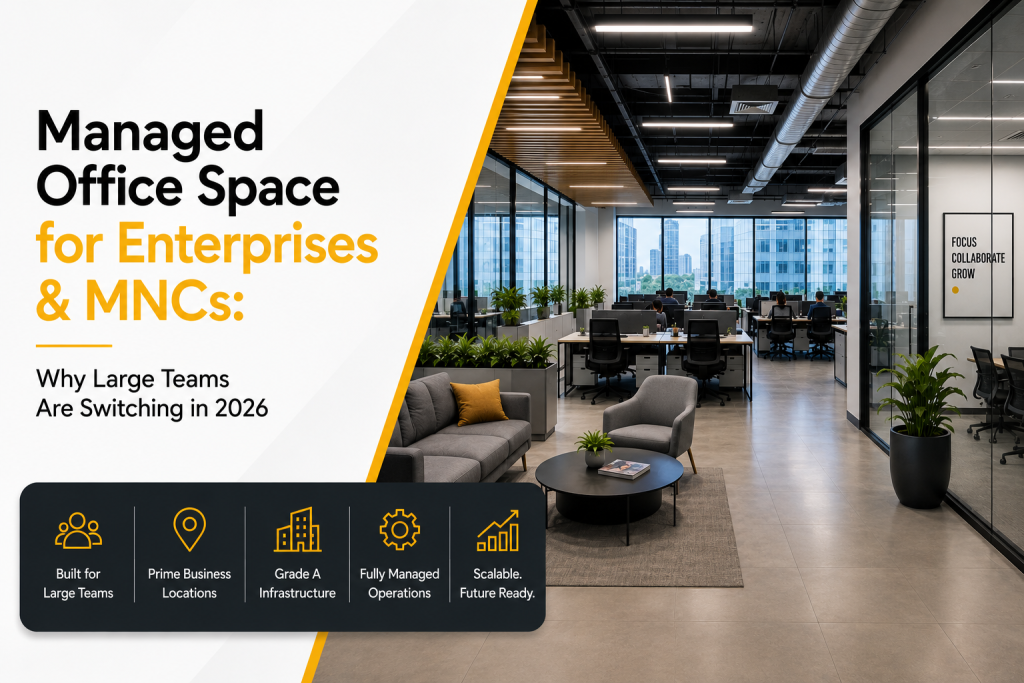
Large enterprise and MNC teams across Delhi NCR are moving away from bare-shell leases toward managed office space, custom-branded, scalable, Grade A floors delivered under a single point of accountability instead of a multi-vendor construction project.
Enterprises and MNCs running large India teams are shifting away from traditional leased offices toward managed office space, and the shift is accelerating in 2026. The reasons are consistent across sectors: a fully fitted-out, Grade A floor can be live in weeks instead of months, headcount can scale up or down without renegotiating a lease, and a single provider owns design, fit-out, and facility operations rather than three separate vendors. This is especially true for the enterprise and GCC persona, since many MNC India entities operate their capability centre and their regional office under the same real estate decision. This guide covers why enterprises are switching, what large-team options exist across Delhi NCR, how MNCs actually use managed office space, and what to evaluate in a managed office partner at enterprise scale.
Why Enterprises Are Switching from Traditional Leases
A traditional bare-shell lease puts the enterprise in the construction business. Design, fit-out, vendor management, and facility operations all sit with the tenant, typically adding six to nine months before a large team can move in, plus the capital expenditure of furnishing and running the floor indefinitely. For an enterprise or MNC entering India, or scaling an existing team quickly, that timeline is often the actual constraint, not budget or headcount approval.
A managed office space model removes that constraint. The enterprise gets a fully operational, Grade A floor with design, fit-out, and day-to-day facility management already handled, under one commercial contract with one point of accountability. Seats can scale up or down as headcount changes, without the multi-year lock-in of a conventional lease. For enterprises managing India as one region among many, this turns office setup from a capital project into a single vendor decision, which is precisely why large teams are switching in 2026.
Where the GCC and MNC Persona Overlap
A large share of India’s Global Capability Center footprint is, by definition, MNC-owned. A GCC is simply the India-based capability centre of a global enterprise, which means the buyer evaluating GCC office space and the buyer evaluating enterprise MNC office space are frequently the same person, often a Country Head, CRE lead, or GCC leader reporting into global real estate or global operations.
This overlap matters practically: enterprises setting up or scaling a GCC should evaluate the same managed office criteria as any large MNC team, branding flexibility, floor scalability, security and compliance posture, and single-point accountability, rather than treating GCC setup as a separate real estate category with different rules.
Managed Office Options for 200+ Seat Teams in Delhi NCR
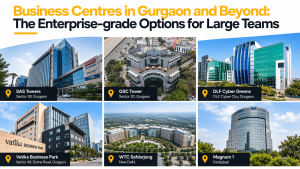
Large enterprise and MNC teams generally need large, contiguous floor plates, not a patchwork of smaller units, along with the ability to combine or add floors as headcount grows. Delhi NCR’s three core geographies each offer this at different price points and prestige levels.
| City / Corridor | Synq.Work centre example | Best suited for |
|---|---|---|
| Gurgaon, Cyber City | DLF Cyber Greens | GCC anchor offices, first India entity |
| Gurgaon, Golf Course Rd Extn | IFC | Enterprise Worksapce Address |
| Gurgaon, Sector-30 | GSC Tower | Enterprise HQ-style leadership floors |
| Gurgaon, Sector-38 | SAS Towers | Enterprise managed office space |
| Gurgaon, Sector-44 | Chimes 142 | GGC Centre |
| Gurgaon, MG Road | DLF Corporate Park | Central, well-connected enterprise base |
| Noida, Sector 16A / Film City | K.S. Corporate Tower | Cost-efficient scale-up, tech and media MNCs |
| Delhi, Aerocity | Aloft | Client-facing, airport-adjacent leadership presence |
| Delhi, Safdarjung Enclave | WTC | Central Delhi Location, Premium Business Hub |
For requirements beyond a single floor, Synq.Work works with enterprise clients to configure or combine floors within a centre, or across multiple Synq.Work locations in the same city, so a 200-plus seat requirement is planned as one managed program rather than several separate leasing conversations.
How MNCs Actually Use Managed Office Space
- As a GCC anchor office. A large, dedicated floor or set of floors housing the capability centre team, often the MNC’s largest single India presence.
- As a regional or satellite office. A smaller footprint supporting sales, support, or a country leadership team, prioritising address and connectivity over floor size.
- As a scaling buffer alongside a headquarters. Additional managed floors taken on when headcount growth outpaces what a long-term leased or owned headquarters can absorb.
In all three cases, the underlying reason is the same: MNCs want an enterprise-grade, custom-branded environment without taking on direct responsibility for design, fit-out, or facility operations in a market where they may not have an established real estate team of their own.
What to Look for in an Enterprise Managed Office Partner
Branding flexibility. Can the provider deliver a custom-branded fit-out that reflects the MNC’s global identity, rather than a generic template floor?
Floor scalability. Can seats be added or reduced within the same building or city as headcount changes, without a full relocation?
Single point of accountability. Does one partner own strategy, design, fit-out, and operations, or does the enterprise still need to coordinate a broker, a fit-out contractor, and a facility management vendor separately?
Security and data posture. Enterprise and GCC buyers increasingly ask about access control and data handling as part of site selection, not as an afterthought. See how Synq.Work approaches this in its smart office technology overview, covering touchless facial recognition access and its in-house, first-party visitor management system.
Managed Office Pricing at Enterprise Scale
Enterprise and MNC managed office pricing in Delhi NCR generally falls within the same broad band as the wider market, roughly ₹8,000 to over ₹35,000 per seat per month, depending on city, micro-market, and fit-out level. What changes at enterprise scale is the negotiation dynamic: a 200-plus seat, multi-year commitment typically unlocks materially better per-seat economics than a smaller, shorter-term booking, since the provider is securing a large, stable occupancy in exchange. Synq.Work’s enterprise centres are positioned within the efficient mid-market band of this range, reflecting Grade A building quality and full facility management without sitting at either pricing extreme.
Published ranges are directional. Enterprise and MNC requirements should always be quoted individually, based on seat count, term, city, and fit-out scope.
Frequently Asked Questions
Talk to Synq.Work’s enterprise team about a scalable, branded managed office across Gurgaon, Noida, or Delhi.
Talk to Our Enterprise Team