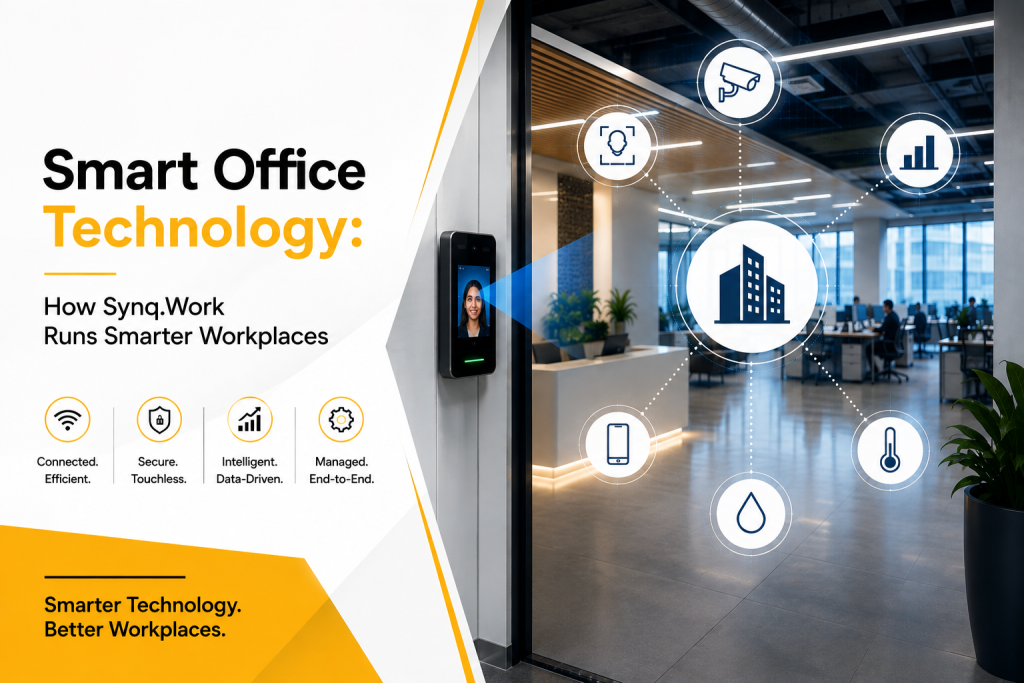
Managed office quality used to be defined by fit-out grade and building spec alone. In 2026, the differentiator is technology, IoT-enabled tracking, touchless facial recognition access, AI-assisted facilities support, and smart HVAC working together to run a more efficient, better-monitored workplace.
Technology has become a core operational pillar for enterprise managed offices, not a peripheral add-on. Synq.Work runs a suite of integrated systems across its centres, IoT-enabled occupancy and energy tracking, facial recognition and touchless access, an in-house visitor management and meeting room booking system, an AI-powered operations ticket raising system, and smart HVAC and energy management, designed to improve the day-to-day experience for enterprise tenants while reducing operating costs that would otherwise be passed on through the management fee. Because the VMS and booking system are built in-house, all visitor and booking data stays first-party on Synq.Work’s own servers, a meaningful advantage for enterprises with strict data compliance requirements. This page explains how each system works and why it matters for enterprises evaluating a managed office space partner.
Technology as a Facility Differentiator
The managed office sector has historically been defined by physical quality, fit-out grade, building spec, and location. Those factors still matter, but they no longer separate a good operator from a great one. The frontier of enterprise workplace experience is now technology: the operators building intelligence into every layer of the environment, from air quality to access control to maintenance response, are the ones delivering a measurably better experience at a lower operating cost.
Synq.Work has made technology a core operational pillar rather than an afterthought. Every centre we operate runs an integrated suite of systems built to improve the day-to-day experience for our clients and reduce operational costs for all parties involved, savings that flow back into more competitive, transparent management fees rather than sitting with the operator.
IoT & Connected Devices
Synq.Work uses IoT-enabled tracking across its centres to monitor occupancy and energy consumption in real time. That data feeds into a facilities dashboard, giving both Synq.Work and the client visibility into how a floor is actually being used, not just how it was designed to be used.
If occupancy data shows certain zones are consistently under-used, Synq.Work works directly with the client to right-size their space allocation, turning underused square footage into a cost conversation rather than a wasted line item.
This same connected-device approach extends to workplace amenities. Select Synq.Work centres deploy BOON smart water dispensers, built on BOON’s patented WaterAI technology, as part of the broader IoT footprint, giving clients real-time visibility into water quality and usage alongside the centre’s occupancy and energy data.
Facial Recognition & Touchless Access
Synq.Work centres have moved to facial recognition as the primary access method, replacing fingerprint and card-based systems with fully touchless entry and exit. The same facial recognition layer also powers touchless attendance tracking, so employees are logged in and out automatically without badging in or touching a shared device, a meaningful hygiene and speed improvement at high-footfall entry points.
Access is managed through a central admin console with granular permissions. Clients can add or remove employees, issue temporary access for visitors or contractors, and pull audit logs directly, without raising a facilities ticket for routine changes.
In-House Visitor Management & Meeting Room Booking
Unlike operators that license off-the-shelf visitor management and room-booking software from third-party vendors, Synq.Work’s VMS and meeting room booking system are built and maintained entirely in-house. Visitor check-ins, pre-registration, host notifications, and meeting room scheduling all run on Synq.Work’s own platform.
That distinction matters beyond convenience. Because there is no external SaaS vendor in the chain, all visitor, meeting, and booking data stays first-party, stored on Synq.Work’s own database and servers rather than passed through or processed by a third party. For enterprises and GCCs with strict data residency, data sovereignty, or third-party risk requirements, this materially simplifies compliance review, there is one data owner to assess, not an operator plus an external software vendor.
For GCCs and regulated enterprises, first-party data architecture is increasingly a shortlisting criterion, not a nice-to-have. Ask any managed office provider directly whether visitor and booking data is processed by a third party before signing.
AI-Powered Operations Ticket Raising System
Synq.Work clients can raise operations tickets, from facility issues to general workplace requests, through a system available 24/7, powered by an AI triage layer that classifies, routes, and tracks every request as it comes in. Common issues are resolved automatically or dispatched directly to the right team without waiting on a human dispatcher, which in Synq.Work’s own operational data has reduced mean-time-to-resolution by more than 60% compared to manual ticket routing.
Smart HVAC and Energy Management
Building energy management typically accounts for 30 to 40% of commercial real estate operating costs, making it the single largest lever available to a facility operator. Synq.Work’s smart HVAC system uses occupancy data and weather forecasting to optimise heating, cooling, and ventilation in real time, rather than running on fixed schedules that waste energy conditioning empty space. The resulting savings are passed through to clients in the form of more competitive management fees, rather than retained as operator margin.
Why This Matters for Enterprise Tenants
- Lower total occupancy cost. Energy optimisation and proactive maintenance reduce the operating costs that ultimately show up in the management fee.
- Fewer facilities headaches for HR and admin teams. Self-service access management and an AI-triaged operations ticket raising system mean faster resolution whenever an issue does come up.
- Better air quality and employee experience. Continuous environmental monitoring keeps meeting rooms and floors within healthy air quality thresholds automatically.
- Stronger security and compliance posture. Touchless facial recognition access with full audit logging supports enterprise security and compliance requirements without extra administrative overhead.
- Simpler data compliance review. An in-house VMS and booking system with 100% first-party data storage means one data owner to assess, not an operator plus an external software vendor, which matters directly to GCCs and regulated enterprises.
For enterprises evaluating a Global Capability Center location, this technology layer is increasingly part of the site-selection conversation, alongside talent access and building grade, since it directly affects both employee experience and long-term operating cost.
Frequently Asked Questions
Book a free site visit to any Synq.Work centre and see the IoT dashboard, access system, and ticket raising system in action.
Book a Free Site Visit