The 18th BRICS Summit closed on 13 September 2026 in New Delhi. Here’s what leaders actually agreed to, what got left out, and why it matters beyond the headlines for anyone tracking India’s Global Capability Centre boom.
BRICS leaders unanimously adopted the New Delhi Declaration on 12 September 2026, backing local-currency trade settlement (explicitly not a common currency), condemning unilateral tariffs and sanctions, demanding UN and IMF reform, and condemning the 2025 Pahalgam terror attack. For the first time since 2023, the declaration made no mention of the Russia-Ukraine war. Xi Jinping and Vladimir Putin attended in person alongside Iran’s president, while Brazil’s Lula and the UAE and Saudi heads of state sent ministers instead. China takes over the BRICS chair for 2027.
We covered the Brics Summit 2026 dates, venue, and agenda before the summit began. Now that it’s over, here’s what leaders actually agreed to, at Bharat Mandapam, Pragati Maidan, the same venue that hosted the 2023 G20 Summit.
Details below, including declaration contents, leader statements, and diplomatic reactions, reflect official announcements and reporting as of 14 September 2026 and may be updated as further coverage and analysis emerges. Check official BRICS 2026 and Government of India channels for the most current information.
Summit Recap: What Actually Happened
India closed out its fourth BRICS chairship with the 18th Summit, held 12–13 September 2026, following a BRICS Business Forum and Bharat Innovates exposition on 11 September at the same venue. The summit capped a year of ministerial meetings under India’s 2026 theme, “Building for Resilience, Innovation, Cooperation and Sustainability,” and marked BRICS’ 20th anniversary as a grouping.
PM Modi framed it as a coming-of-age moment for the bloc: “BRICS is poised to enter its third decade. The world now expects concrete results from us, not just ideas and commitments.”
The single biggest outcome of the two days was procedural as much as substantive: all 11 full members reached consensus on a joint declaration, something that wasn’t guaranteed. A BRICS foreign ministers’ meeting in Delhi back in May 2026 had ended without a joint statement, largely over splits between Iran and the UAE tied to the wider West Asia conflict. Getting eleven governments, including two with active regional tensions, to sign one document was, in the words of former Indian Foreign Secretary Nirupama Menon Rao, a “significant diplomatic success.”
Inside the New Delhi Declaration
Modi announced the unanimous adoption directly: “No member has raised any objection. The New Delhi Declaration 2026 is adopted unanimously.” Here’s what the roughly 140-paragraph, ~17,800-word document actually says.
Trade and de-dollarization, but no common currency
The declaration backs local-currency trade settlement and interoperable cross-border payment systems through the BRICS Payment Task Force. It explicitly stops short of creating a shared BRICS currency, India’s Ministry of External Affairs confirmed there is no such proposal “as of now.” The New Development Bank was encouraged to keep expanding local-currency financing, a target it has already exceeded.
On trade friction, the declaration voices “serious concerns about the rise of unilateral tariff and non-tariff measures which distort trade and are inconsistent with WTO rules,” language widely read as aimed at recent U.S. tariff actions, without naming the United States directly. It also calls for eliminating unilateral coercive measures and secondary sanctions not authorized by the UN Security Council.
Global governance reform
Leaders reiterated calls to reform the UN Security Council to better represent Africa, Asia, and Latin America, with China and Russia specifically backing India’s and Brazil’s aspirations for a greater UN role. The declaration also pushed for reform of the IMF and World Bank, including implementation of the 16th General Review of Quotas.
Terrorism and security
The declaration strongly condemned the April 2025 Pahalgam attack in Jammu and Kashmir, the deadliest attack on civilians in India since 2008, and reaffirmed a “zero tolerance” stance on terrorism.
West Asia, and the conflict BRICS didn’t name
On the Middle East, the declaration calls for “maximum restraint,” protection of civilians, humanitarian access in Gaza, and support for a two-state solution, carefully worded to bridge the gap between member states with opposing regional interests.
For the first time since 2023, the declaration does not name Ukraine or the Russia-Ukraine war, referring only generically to “conflicts in many parts of the world” and calling for resolution through “dialogue, consultation and diplomacy.” Both the 2024 Kazan and 2025 Rio declarations had referenced the war directly; this year’s silence is a notable shift.
Technology, energy, and health
The declaration endorses cooperation on AI governance and digital public infrastructure, a BRICS Incubator Network for startups, a BRICS Mission for Healthy Lifestyle running 2026–2029, and continued work toward a BRICS Grain Exchange. On energy, it acknowledges fossil fuels will remain part of the mix for developing economies while backing an “orderly, equitable” transition under the Paris Agreement.
Who Showed Up, and Who Didn’t
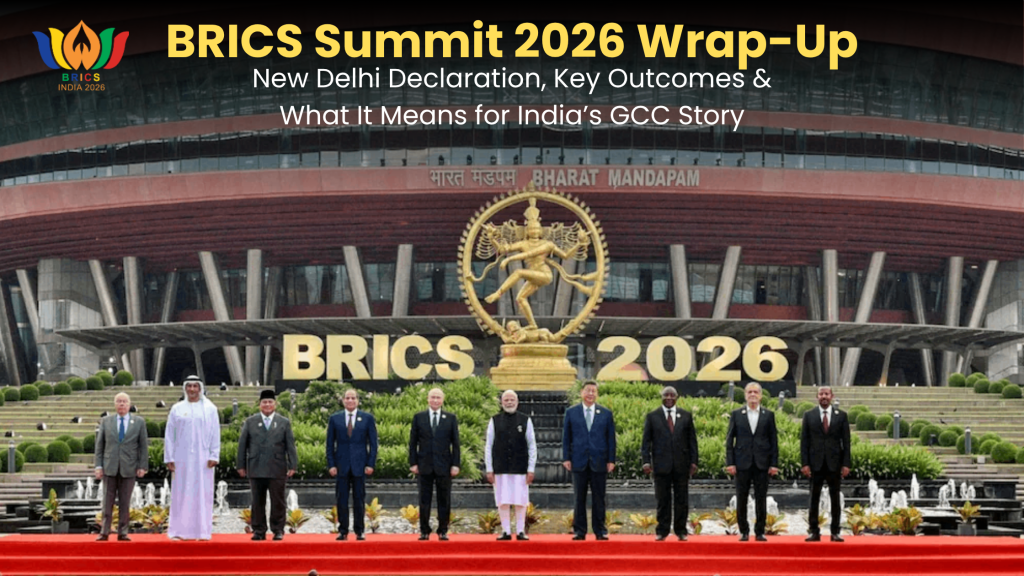
PM Modi hosted. Chinese President Xi Jinping attended in person for the first time in India since 2019, alongside Russian President Vladimir Putin, his first in-person BRICS summit outside Russia since 2022, and Iran’s President Masoud Pezeshkian. South Africa’s Cyril Ramaphosa, Egypt’s Abdel Fattah el-Sisi, Ethiopia’s Abiy Ahmed, and Indonesia’s Prabowo Subianto also attended.
| Leader / country | Attendance | Notable context |
|---|---|---|
| Xi Jinping, China | In person | First India visit since 2019 |
| Vladimir Putin, Russia | In person | First in-person BRICS summit outside Russia since 2022 |
| Masoud Pezeshkian, Iran | In person | Held direct talks with UAE representative |
| Lula, Brazil | Foreign minister sent | Sole original 2009 BRIC leader still in office; election looming |
| UAE & Saudi Arabia | Foreign ministers sent | Saudi formal accession still unresolved |
Key Bilateral Meetings
Modi–Putin: The two leaders discussed trade, energy, and defence, reaffirming a $100 billion bilateral trade target by 2030, a steep climb from the current roughly $60 billion, requiring sustained double-digit annual growth.
Modi–Xi: Xi’s first India visit in about seven years touched on border stability, trade imbalances, and connectivity. India’s Ministry of External Affairs said both sides “expressed commitment to a fair, reasonable, and mutually acceptable resolution of the boundary question,” continuing a cautious post-Galwan thaw that has already seen direct flights restored between the two countries.
Iran–UAE: Pezeshkian and the UAE’s representative held what Reuters described as the highest-level Iran–UAE meeting since their 2026 conflict broke out, talks that helped unlock consensus on the declaration’s Middle East language.
Global Reactions
UN Secretary-General António Guterres told the summit: “Today’s economic, demographic and geopolitical realities are not those of 1945. Our institutional structures must reflect it.”
Xi Jinping called on BRICS to become an “active, stabilising and positive force in international affairs” and confirmed China will host the 19th BRICS Summit in 2027 as the incoming chair. Putin criticized countries “accustomed to thinking in colonial categories” over their use of tariffs and sanctions, while the Kremlin said both Xi and Modi had offered to help facilitate Ukraine peace talks.
A specific U.S. government response to the New Delhi Declaration had not been confirmed through major outlets at the time of writing, though it follows earlier tariff pressure the U.S. had placed on India through 2025 tied to its energy trade with Russia.
BRICS Summit 2026: dates, venue, and full agenda (Blog 1)What It Means for India’s GCC Story
Set aside the geopolitics for a moment. Three threads from this summit connect directly to the conversation every global enterprise is already having about India: talent, infrastructure, and stability.
- Payment rails and digital infrastructure got a global stage. The push for interoperable, local-currency payment systems, built on the same digital public infrastructure thinking behind UPI, signals that India’s tech stack is now referenced in global trade policy, not just domestic conversations.
- Supply-chain diversification is now explicit policy language. Modi’s own remarks warned that “weaponisation of technology and critical minerals” could hinder shared progress, and pushed resilient, diversified supply chains, the same strategic logic driving multinationals to build out GCCs in India as a hedge against concentration risk elsewhere.
- Hosting capability is a quiet signal of operational maturity. Running a three-day, 11-member, multi-agenda summit, with bilateral tracks, a business forum, and a unanimous declaration, at the venue that ran the G20, is the kind of execution capability site-selection teams notice, even if it never appears in their formal evaluation criteria.
For enterprises actively evaluating or scaling a GCC setup in India, none of this changes the fundamentals, cost, talent depth, and delivery speed still decide the business case. But summit weeks like this one are when that business case gets a louder, more visible backdrop.
The same fundamentals that make India a credible host for eleven heads of state, political stability, scaled digital infrastructure, and a deep technical talent base, are the exact fundamentals global enterprises weigh when deciding where to set up their next Global Capability Centre.
FAQ: BRICS Summit 2026
What happened at the BRICS Summit 2026?
The 18th BRICS Summit was held 12–13 September 2026 at Bharat Mandapam, New Delhi. Leaders unanimously adopted the New Delhi Declaration, backing local-currency trade settlement, condemning unilateral tariffs and sanctions, calling for UN and IMF reform, and condemning the 2025 Pahalgam terror attack. Notably, the declaration did not mention the Russia-Ukraine war.
Did BRICS create a common currency in 2026?
No. The New Delhi Declaration backed local-currency trade settlement and cross-border payment interoperability, but explicitly did not create a common BRICS currency. Indian officials clarified there was no proposal for a shared currency “as of now.”
Who attended the BRICS Summit 2026 in person?
PM Narendra Modi hosted. Chinese President Xi Jinping (his first India visit since 2019), Russian President Vladimir Putin, and Iran’s President Masoud Pezeshkian attended in person, along with leaders from South Africa, Egypt, Ethiopia, and Indonesia. Brazil’s President Lula, and the heads of state of the UAE and Saudi Arabia, sent ministers instead.
What is the New Delhi Declaration 2026?
The New Delhi Declaration is the roughly 140-paragraph consensus document adopted unanimously by all BRICS members on 12 September 2026. It covers trade, de-dollarization, terrorism, West Asia, UN and IMF reform, energy security, and technology cooperation.
Did the BRICS 2026 declaration mention Ukraine?
No. Unlike the 2024 Kazan and 2025 Rio declarations, the 2026 New Delhi Declaration did not name Ukraine or the Russia-Ukraine war, referring only generically to “conflicts in many parts of the world” and calling for resolution through dialogue and diplomacy.
Which country will host the next BRICS Summit?
China will chair BRICS in 2027 and host the 19th BRICS Summit. Modi formally passed the chairship to Xi Jinping at the close of the New Delhi summit.
How does BRICS Summit 2026 relate to India’s GCC growth story?
The summit’s focus on payment interoperability, supply-chain diversification, and India’s expanding global standing reinforces the same fundamentals, digital infrastructure, talent depth, and geopolitical stability, that global enterprises weigh when setting up Global Capability Centres (GCCs) in India.
Evaluating India for your next GCC?
Talk to Synq.Work about occupancy, cost, and delivery speed for a managed GCC office space in Gurgaon, Noida, or Delhi.
Talk to Our GCC TeamRelated reading
BRICS Summit 2026: dates, venue, and agenda
(Blog 1)
Explore Synq.Work GCC office space
solutions
Data sources and credits
- pmindia.gov.in — Full text of the New Delhi Declaration, 12 September 2026
- Reuters, Al Jazeera, SCMP, Bloomberg — Summit attendance, bilateral meeting coverage, and leader statements
- Government of India, Ministry of External Affairs — Official readouts of Modi-Putin and Modi-Xi bilateral meetings
- United Nations, Kremlin press office — Direct statements from Guterres, Putin, and Peskov
All information current as of 14 September 2026. Post-summit analysis and reactions continue to develop; this recap will be updated as new official statements are published.