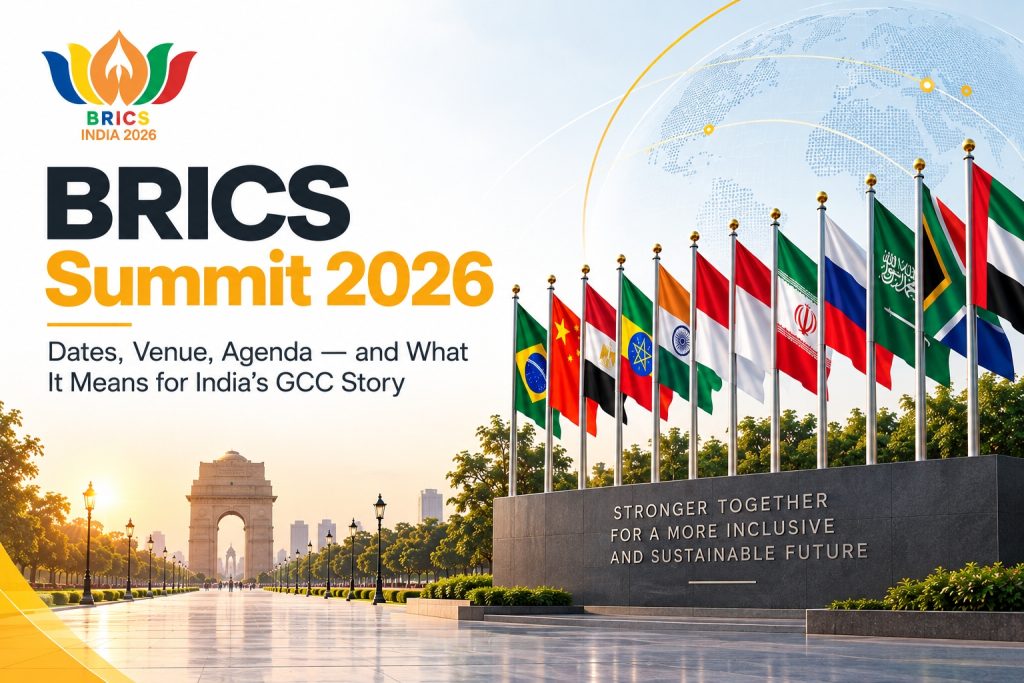
The 18th BRICS Summit 2026 lands in New Delhi on 12–13 September 2026. Here’s everything confirmed so far, plus why a two-day diplomatic gathering is also a signal for anyone tracking India’s Global Capability Centre boom.
The 18th BRICS Summit will be held on 12–13 September 2026 at Bharat Mandapam, Pragati Maidan, New Delhi, with India hosting as BRICS Chair for 2026. The summit caps a year of ministerial meetings under the theme “Building for Resilience, Innovation, Cooperation and Sustainability.” A BRICS Business Forum and a Women’s Business Alliance meeting precede the leaders’ meeting on 11 September at the same venue.
When and Where Is BRICS Summit 2026?
India is hosting the 18th BRICS Summit on 12–13 September 2026 in New Delhi. This is India’s fourth time chairing BRICS, after 2012, 2016, and 2021, and it assumed the 2026 chairship on 1 January 2026.
The venue is Bharat Mandapam at Pragati Maidan, the same convention centre that hosted the G20 Summit. Ahead of the leaders’ meeting, the BRICS Business Forum and a Women’s Business Alliance meeting are scheduled for 11 September at the same venue, effectively turning it into a three-day window (11–13 September) of high-level economic and diplomatic activity in Delhi. Delhi has declared 11 September a holiday for government offices, autonomous bodies, and PSUs, and schools across the capital are closed that day, with elevated security and traffic restrictions expected across the city through the 13th.
What Is the Theme of BRICS Summit 2026?
India’s 2026 chairship theme is “Building for Resilience, Innovation, Cooperation and Sustainability.” It’s meant to keep the summit focused on delivery, trade mechanics, technology cooperation, and institutional reform, rather than becoming a purely political statement against any bloc.
Who Is Attending the BRICS Summit 2026?
Prime Minister Narendra Modi will host. Russian President Vladimir Putin has confirmed his attendance. Chinese President Xi Jinping is also expected, a visit that, if it happens, would be his first to India since 2019. Given the current state of India-China relations, a bilateral Modi-Xi meeting on the sidelines is one of the things diplomatic watchers are tracking most closely.
Beyond the two headline visits, BRICS now includes 11 full members, the original five plus Egypt, Ethiopia, Iran, Saudi Arabia, and the United Arab Emirates (added in 2024) and Indonesia (which joined as a full member in 2025), alongside roughly 10 partner countries. New Delhi will be hosting a genuinely large multilateral gathering, one of the biggest hosted in India since the 2023 G20 Summit.
What’s on the Agenda?
Based on the ministerial meetings that have run through 2026 under India’s chairship, expect the leaders’ agenda to centre on:
- Local-currency trade and de-dollarization mechanics, including progress on BRICS Pay, a proposed payment messaging layer linking Russia’s SPFS, China’s CIPS, India’s UPI, and Brazil’s Pix.
- CBDC interoperability, with India’s central bank pushing a framework to link the digital rupee with other BRICS digital currencies.
- Reform of global institutions, a recurring BRICS talking point on rebalancing influence at the IMF, World Bank, and UN Security Council.
- Trade, technology, and industrial cooperation, the subject of several sectoral sessions India has already run this year.
- Food and energy security, framed under the “resilience” pillar of the 2026 theme.
Why This Matters Beyond the Headlines: India’s GCC Moment
A BRICS summit is a two-day diplomatic event. But it’s also a visible marker of something that’s been building for years and matters directly to anyone tracking India’s Global Capability Centre story.
The same fundamentals that make India a credible host for eleven heads of state, political stability, a scaled digital public infrastructure stack (UPI is literally on the summit agenda), a deep English-speaking technical talent base, and a growing seat at the table on global trade and technology rules, are the exact fundamentals global enterprises weigh when they decide where to set up their next GCC.
That’s not a coincidence, and it’s not new information for anyone already operating a centre in India. But summit weeks like this one are when the signal reaches an audience beyond the industry: CFOs, COOs, and site-selection teams at companies who haven’t made the India move yet, watching New Delhi host this scale of event and quietly re-rating the country’s global standing.
For GCCs already running out of Gurugram, Noida, Delhi NCR, or Mumbai, the practical takeaway is simpler: expect a short window of tighter movement and security around central Delhi from 11–13 September if your operations, vendors, or leadership travel touch that corridor, and expect the usual post-summit bump in enquiries from global boards asking “why India, why now,” a conversation the operator-first managed office model exists to answer with facts on occupancy, cost, and delivery speed rather than pitch decks.
Frequently Asked Questions
Talk to Synq.Work about occupancy, cost, and delivery speed for a managed office in Gurgaon, Noida, or Delhi.
Talk to Our GCC Team