What a managed office for GCC is, what it includes, who it suits, and how it compares with build-to-suit and bare-shell leases, with a comparison table and answers to the questions global enterprises ask most.
Managed office for GCC is a private office that one partner designs, builds, equips and operates for a Global Capability Centre under a single contract, covering the workspace, IT infrastructure, security, facility management and day-to-day operations. Synq.Work offers this as MO-GCC in Gurgaon, Delhi, Noida and Mumbai.
Compared with a bare-shell lease, the managed model removes the fit-out and facility set-up burden. Compared with build-to-suit, it trades full control of the building specification for one accountable partner and flexible scaling.
What Is a Managed Office for GCC?
A Global Capability Centre is an in-house centre that a global company runs in India to deliver technology, operations, analytics, engineering or support work for the parent. Standing one up means finding space, building it out, connecting it securely and then running it every day. A managed office for GCC packages that whole workplace layer into one service from a single partner, so the GCC’s leadership can concentrate on hiring, delivery and the parent’s mandate.
Synq.Work calls its version of the service MO-GCC, short for Managed Office for Global Capability Centres. People also search for it as managed office GCC or managed office space for GCC. The idea is the same in each case: an enterprise-grade, fitted and operated office delivered under one contract rather than assembled from a lease, a contractor, an IT vendor and a facilities provider.
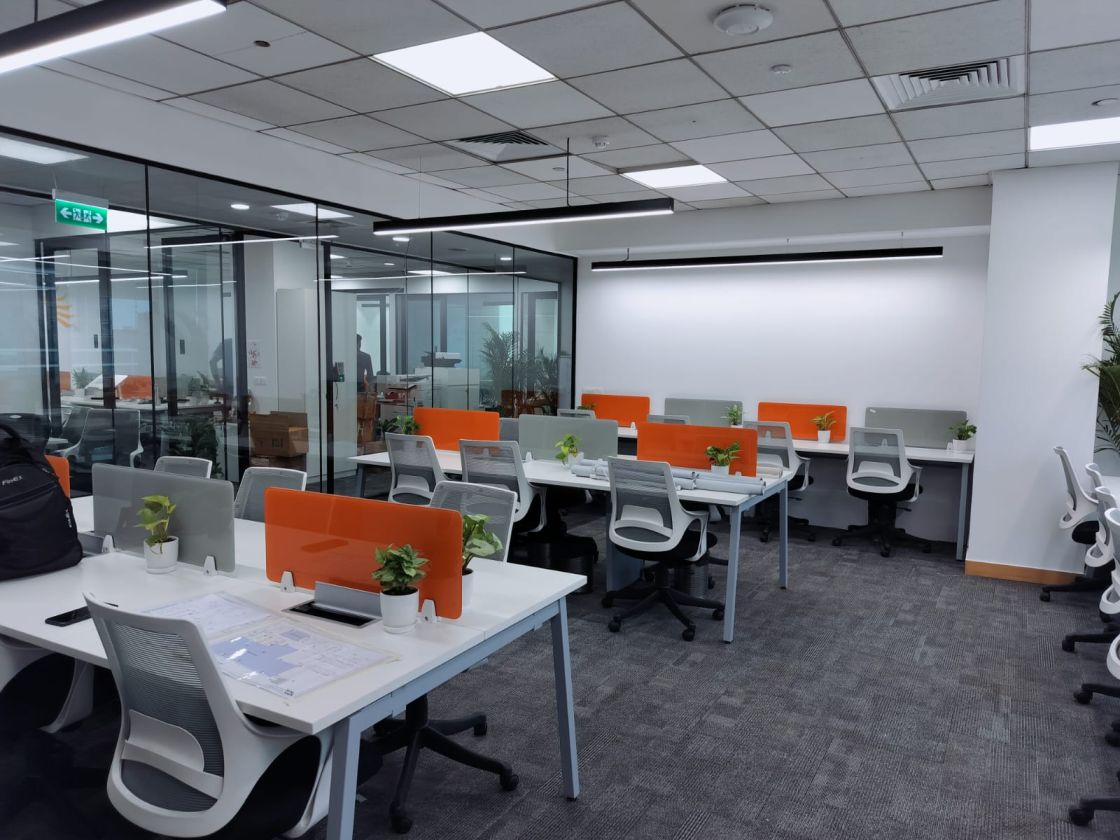
What a Managed Office for GCC Includes
Scope is agreed per engagement, but MO-GCC from Synq.Work is built around six components, all delivered by one partner.
| Component | What it covers |
|---|---|
| Workspace strategy and GCC planning | Location, workspace model and office strategy for setting up a scalable Global Capability Centre in India. |
| Office design and build | Space planning, branded interiors, meeting rooms, collaboration zones and executive cabins aligned to the GCC’s operations. |
| Fully managed operations | Housekeeping, facility management, internet, utilities, security and maintenance run by the partner. |
| Enterprise IT infrastructure | Secure internet, access control systems, server rooms and AV setup for GCC operations. |
| Flexible team scaling | Room to expand or optimise the footprint as the GCC grows, across cities. |
| Employee experience and hospitality | Managed reception, pantry services, meeting room management and hospitality-led amenities. |
- One partner: design, build and operations sit under one contract.
- One scope: IT, access control and facility management are part of the offer, not separate procurement.
- One point of accountability: the parent’s reviewers deal with a single provider on the workplace.
How a Managed Office for GCC Engagement Runs
The service follows a milestone-driven path from the first conversation to daily operations.
- Discovery and strategy. Team size, operational goals, location preferences and the GCC’s expansion plan.
- Design and build. A customised office aligned with the parent’s brand, operations and workforce needs.
- Deploy and operate. Office set-up, infrastructure deployment, daily operations and ongoing facility management.
- Scale and optimise. Expansion across locations with flexible managed office models as the GCC grows.
Who a Managed Office Space for GCC Suits
A managed office space for GCC is built for global enterprises that want an India centre without running a real estate and facilities programme alongside it. It tends to fit these cases:
- New GCCs establishing a first India presence and wanting one partner for the workplace.
- Growing GCCs that need to add teams or a second location without a fresh procurement cycle each time.
- Specialised centres such as technology hubs, back-office operations centres, innovation labs, support centres and enterprise delivery hubs.
- Parents with strict security reviews that prefer a single accountable provider for access control, IT infrastructure and site operations.
It is a weaker fit where the parent wants full ownership of the building specification over a long horizon, or already has an in-house facilities function it wants to keep running. Those cases point towards build-to-suit or a bare-shell lease, covered next.
Managed Office for GCC vs Build-to-Suit vs Bare-Shell Lease
The table compares the three common ways to house a GCC. It describes how each model usually works in general terms, so confirm specifics with each landlord or provider. For a deeper look at the first two, read Synq.Work’s managed office vs build-to-suit comparison for GCC in India.
| Factor | Managed office for GCC | Build-to-suit | Bare-shell lease |
|---|---|---|---|
| Who designs and builds | One partner designs and builds the fitted office | Developer builds to the tenant’s specification; tenant manages design inputs and approvals | Tenant appoints designers and contractors and manages the fit-out |
| Who operates the site | Partner runs facility management, security and daily operations | Tenant arranges facility management and services | Tenant arranges facility management and services |
| IT and security set-up | Included in scope: secure internet, access control, server rooms, AV | Tenant plans and deploys | Tenant plans and deploys |
| Contract structure | One contract for design, build and operations | Lease plus separate vendor contracts | Lease plus separate vendor and contractor contracts |
| Commitment and flexibility | Flexible scaling across managed office models | Typically a long lease tied to the built asset | Lease term plus the tenant’s own fit-out investment |
| Control over design | Customised to the GCC’s brand and operations within the partner’s delivery model | Highest control over the building specification | High control over layout and finishes |
| Best suited to | GCCs that want one accountable partner and a faster route to a working office | Large, long-horizon campuses where specification control matters most | Teams with an in-house real estate and facilities function |
General comparison of how each model usually works. Terms vary by landlord, provider and engagement.
How to Choose Between the Three Models
- Start with the horizon. If the GCC’s size and location are uncertain, a managed office for GCC keeps the commitment flexible. If the horizon is long and fixed, build-to-suit can make sense.
- Count your internal capacity. A bare-shell lease works when you have people who can run design, procurement, IT and facilities. If you do not, the managed office model carries that load.
- Check the parent’s review process. Security and vendor-risk teams usually favour fewer vendors and clearer accountability.
- Decide where control matters. List the design and infrastructure decisions the parent must own, then test each model against that list.
Many GCCs also start in a managed space and move to a larger or purpose-built home later. The two stages are not mutually exclusive, so ask each provider how scaling and exit are handled.
Where MO-GCC Fits in the GCC Lifecycle
GCCs rarely follow one path. Some begin with a small leadership and engineering team and add functions over time. Others launch with a defined mandate and a larger first cohort. The managed model suits both because the workplace is delivered as a service. A first phase can be set up quickly with the partner handling design, infrastructure and operations, and later phases can add space, add a city or move the centre towards a more permanent home.
That flexibility matters because the parent’s plans often change as the GCC proves its value. A centre that begins as a delivery hub may take on product engineering, analytics or shared services. Agreeing early how the partner handles expansion, reconfiguration and exit keeps those changes from turning into a new procurement exercise.
What to Look for in a Provider
- A clear scope document. The provider should state what is included in design, build, IT, security, facility management and employee experience, and what is excluded.
- Evidence of delivered GCC projects. Ask to visit a centre and speak with the operations team. Synq.Work lists DLF Cyber Greens and IFC in Gurgaon as delivered MO-GCC projects.
- Enterprise IT and access control. Confirm how connectivity, server rooms, AV and entry control are specified and managed.
- Flexible scaling terms. Understand how the footprint can grow, shrink or move across cities.
- Transparent contract terms. Check service levels, notice and lock-in terms, audit rights and what happens at exit.
- A single accountable contact. One partner for design, build and operations is the core advantage of the model, so test that it holds in practice.
Common Mistakes When Choosing a Workplace Model for a GCC
- Treating the decision as only a rent comparison. A bare shell may look simpler on paper, but the fit-out, IT, security and facility management still have to be designed, procured and run by someone.
- Locking in too early. If headcount and scope are still moving, a long commitment tied to a fixed footprint can become a constraint.
- Leaving the parent’s reviewers until the end. Security, legal and vendor-risk teams should see the proposed set-up early, so changes do not delay go-live.
- Ignoring the operating phase. Design is a one-off task. Housekeeping, maintenance, security and meeting room management run every day for years.
- Choosing a location by address alone. Commute, talent catchment and connectivity matter as much as the building.
Security and Compliance Questions to Ask Any GCC Workplace Provider
A GCC extends its parent’s control environment, so the parent’s information security, legal and internal audit teams will review the workplace. Ask any provider how entry is controlled and logged, where visitor and access data is stored, who holds administrative access to on-site systems, and how incidents are reported to you. India’s Digital Personal Data Protection Rules were notified on 13 November 2025, and the main data fiduciary obligations take effect on 12 May 2027 (AZB & Partners timeline), so contracts signed now should anticipate them. Take legal advice on how the rules apply to your structure.
MO-GCC Projects and Cities
Synq.Work offers a managed office for GCC in Gurgaon, Delhi, Noida and Mumbai. It lists DLF Cyber Greens in Cyber City and IFC on Golf Course Extension Road in Gurgaon as delivered MO-GCC projects. For a micro-market view of Gurgaon, see Synq.Work’s guide to a managed office for GCC in Gurgaon.

Talk to the team through the MO-GCC page to discuss your team size, preferred city and security requirements.
Frequently Asked Questions
Share your team size, preferred city and parent-company requirements, and we will walk you through MO-GCC.