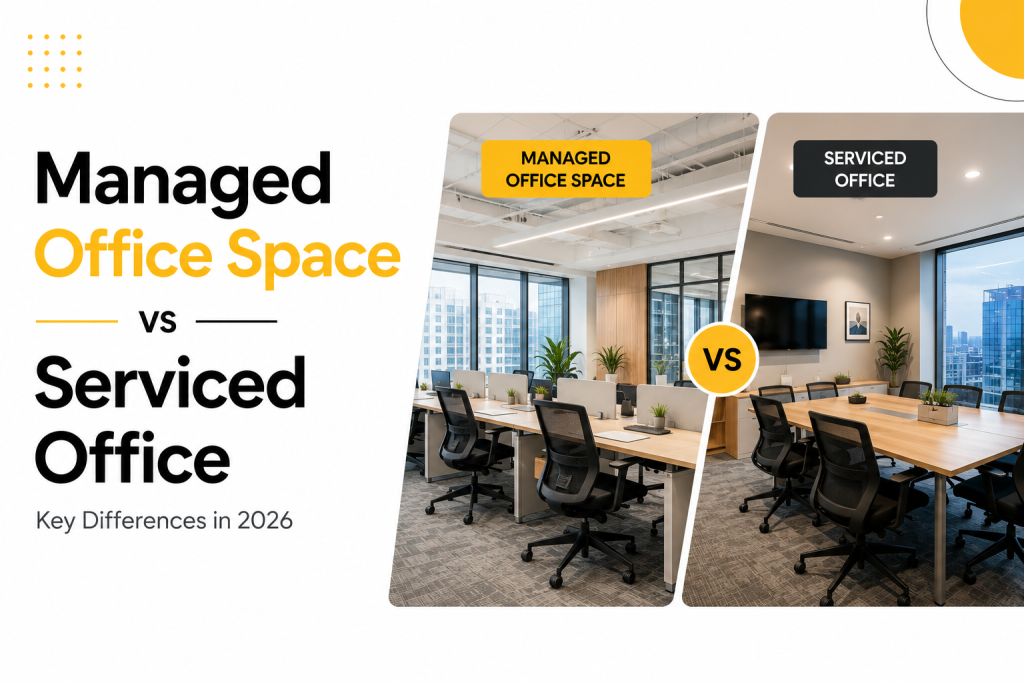
Both are fully furnished, professionally run, and avoid a traditional lease. They are still built for different companies at different stages. Here is exactly where they diverge, and which one fits your team.
A serviced office is a private suite inside a shared business centre, standardised, fast to occupy, and built for teams under roughly 20 people who do not need dedicated branding or infrastructure. A managed office is a private floor or building reserved exclusively for one company, fully customised to its branding, IT, and security requirements, and built for teams of 20 to 500 seats ready for a 12 to 36-month commitment. Per-seat pricing between the two often overlaps. The real difference is exclusivity, customisation, and what happens to your privacy and branding once you are inside the building.
Serviced office and managed office get used interchangeably often enough that most people assume they are the same thing with two names. They are not. Both sit in the same broad category, fully furnished, professionally operated, no CapEx, no long lock-in, but they solve for different company sizes and different privacy requirements. Confusing the two usually shows up later, when a growing team realises its “managed office” is actually sharing a reception desk and a boardroom with three other companies.
Part of the confusion is that both models emerged from the same shift away from traditional leasing, and both are frequently marketed under the broader “flexible workspace” umbrella alongside coworking. But a business centre selling serviced suites and a provider building a dedicated floor for one enterprise client are running fundamentally different operations, with different economics, different privacy guarantees, and different ceilings on how large a team they can comfortably support. Getting this distinction right before signing anything matters more as your team grows past the point where a shared building stops being a minor inconvenience and starts being an operational constraint.
What Is a Serviced Office?
Structure
A private, furnished suite inside a larger business centre or building, operated by a single provider who leases rooms and suites to multiple, unrelated companies.
What’s shared
Reception, pantry, meeting rooms, and common areas are typically shared with other tenant businesses in the same building.
A serviced office gives a small team its own lockable, private room or suite, professionally furnished, with internet, reception support, and access to shared meeting rooms included. The appeal is speed: walk in with a laptop and the space is ready. Contracts are usually short and flexible, often running month to month or in short blocks, which makes serviced offices a natural fit for teams under roughly 15 to 20 people, early-stage companies, or a business testing a new city before committing further.
The trade-off is that a serviced office is not private in the fullest sense. Other companies operate in the same building, sometimes on the same floor, sharing the same reception staff and the same visitor experience. Branding is minimal to none: the building looks like the operator’s brand, not yours. For a two-person consulting firm or a 10-person regional sales office, none of this matters much. For a team handling client-sensitive work, or one that wants its own brand visible the moment someone walks through the door, it becomes a real limitation rather than a minor cosmetic one.
Serviced offices also tend to price meeting rooms, extra desks, and after-hours access as add-ons rather than folding them into one flat fee, which is worth checking carefully before comparing headline rates across providers.
What Is a Managed Office?
Structure
A private, dedicated floor or building built and operated exclusively for one occupier. No other company shares the space, the network, or the reception.
What’s included
Furniture, enterprise IT, security, housekeeping, and facilities management, all built to the occupier’s own specifications and fully branded to that company.
A managed office Space is what a serviced office becomes once a company outgrows shared space and needs true exclusivity. The provider still builds, furnishes, and operates the space end to end, but the entire floor or building belongs to one occupier only. That means a custom floor plan, the occupier’s own branding on the walls and reception, a dedicated network perimeter, and security protocols configured to that specific company’s requirements, whether that is a 30-person startup or a 300-seat GCC.
Contracts typically run 12 to 36 months rather than the shorter, more flexible terms common to serviced offices, and the model suits teams from roughly 20 seats up to 500 or more. This is also the format most Global Capability Centres and enterprise teams now default to, since it delivers the privacy and compliance-readiness a shared building cannot.
The longer commitment is not simply a cost of admission. It reflects the fact that a managed office is built specifically for one occupier’s floor plan and specification, work that would not make commercial sense on a month-to-month basis. In exchange, the occupier gets a space that behaves like a real, permanent office rather than a rented suite, with room to expand within the same building as headcount grows, typically without renegotiating the entire agreement.
What is managed office space? Complete 2026 guideKey Differences: Side-by-Side Comparison
| Dimension | Serviced Office | Managed Office |
|---|---|---|
| Exclusivity | Shared building with other tenant companies | Entire floor or building reserved for one occupier |
| Customisation | Minimal; standardised layout and finishes | Full; custom floor plan, IT spec, security protocols |
| Branding | Operator’s brand throughout the building | Occupier’s own brand on signage, walls, and reception |
| Lease term | Flexible; often month to month or short blocks | 12–36 months typical |
| Setup timeline | Immediate to a few days; walk-in ready | 2–8 weeks standard config; 60–90 days for custom builds |
| Team size fit | Typically under 15–20 seats | 20 to 500+ seats |
| Network and security | Often shared building Wi-Fi and common infrastructure | Dedicated network perimeter, compliance-ready security |
| Best for | Small teams, early-stage companies, short-term city entry | Growing teams, enterprises, GCCs needing privacy and scale |
Cost Comparison: What You Actually Pay For
Per-seat pricing between the two models overlaps more than most people expect. Both typically fall in a broadly similar range in Grade A buildings, and the headline monthly figure alone rarely tells you which one is the better deal. What differs is what that figure includes.
| Cost factor | Serviced Office | Managed Office |
|---|---|---|
| Per-seat monthly fee | Broadly comparable to managed office at the per-seat level in Grade A buildings | Broadly comparable; varies more by city, floor size, and configuration |
| What’s bundled in | Shared amenities, shared infrastructure, standard finishes | Dedicated infrastructure, private network, custom branding, compliance-ready setup |
| Customisation cost | Limited scope to customise regardless of budget | Built into the fee structure rather than charged as a separate project |
| Lease term discount | Less relevant given short, flexible terms | Meaningful; shorter 12-month terms typically cost more per seat than 24–36 month commitments |
| Scale economics | Limited benefit; small suites don’t scale down per-seat cost much | Per-seat cost improves meaningfully above 100 seats as fit-out and operations spread wider |
Comparing serviced and managed office purely on the quoted per-seat rate misses the point. A serviced office at a lower headline rate can still be the wrong economic choice for a 60-person team, since its shared, standardised structure was never built to scale that far. A managed office often becomes the better value once a team is large enough, and stable enough in its headcount plans, to benefit from dedicated infrastructure and better lease-term pricing.
Which One Should You Choose?
Most companies do not choose once and stay there forever. A common trajectory is starting in a serviced office while the team is small, then moving into a managed office once headcount, branding needs, or compliance requirements outgrow what a shared building can offer.
The switching point is rarely a fixed headcount number so much as a moment when the shared building starts costing more than it saves, in lost privacy, in a brand that never quite feels like yours, or in a compliance conversation that a shared network cannot support. Teams that plan for this transition in advance, rather than treating it as a forced move under time pressure, tend to negotiate better terms on the managed office side simply because they are not scrambling.
FAQ
What is the difference between managed and serviced office space?
A serviced office is a private, furnished suite inside a larger business centre, typically sharing reception, pantry, and common areas with other tenant companies in the same building. A managed office is a private, dedicated floor or building built exclusively for one occupier, with custom branding, a dedicated network, and no shared common areas with other companies. The core distinction is exclusivity: serviced offices share the building with other businesses, managed offices do not.
Is serviced office the same as managed office?
No, they are related but distinct models. Both are fully furnished, professionally operated, and avoid the capital expenditure and long lock-in of a traditional lease. But a serviced office is one tenant among several in a shared business centre, while a managed office is built and reserved entirely for a single company. Serviced offices generally suit smaller teams needing a fast, low-commitment setup. Managed offices suit larger teams needing privacy, branding, and dedicated infrastructure at scale.
Which is more customisable — managed or serviced office?
A managed office is significantly more customisable. Because the space is built exclusively for one occupier, the floor plan, branding, IT specification, and security protocols can all be tailored to that company’s requirements. A serviced office is largely standardised, since the same building and common infrastructure serve multiple tenant companies, which limits how much any single business can customise the layout, branding, or technical setup.
Ready for a fully managed office of your own?
Synqwork builds and operates private, fully branded managed offices across New Delhi, Gurugram, Faridabad, Mumbai, and Chennai. No shared reception, no shared network, no compromises on privacy.
Talk to Synqwork about your workspaceRelated reading
What is managed office space? Complete 2026 guide (Blog 1)
Managed office checklist: 25 things to verify before you sign
Explore Synqwork managed office locations
Data sources and credits
- Enterprise workspace market research, 2026 — Managed office pricing benchmarks (Rs 10,000–25,000 per seat per month, Grade A buildings), lease term pricing dynamics, and scale economics above 100 seats
- Commercial real estate advisory research, 2026 — Serviced office structure and shared-building operating model definitions
- Published flexible workspace industry research, 2026 — City-level per-seat pricing ranges and setup timeline benchmarks (2–8 weeks standard, 60–90 days custom builds)
- CBRE-FICCI — Flex-plosion: India’s Flexible Workspaces Era, March 2026 (enterprise share of flex demand by value)
All data current as of May 2026. Pricing and terms vary by city, building grade, and provider. This guide is informational — contact Synqwork for a tailored recommendation for your team size and requirements.